Best Couples Massage Near Me | DIY & Rapid City
The Complete Guide to Couples Massage Benefits, Comfort, At-Home Techniques, Professional Experiences, Prices, and Booking
A couples massage should be more than two people receiving massages at the same time. It should be an experience worth remembering.
Whether you're planning a relaxing afternoon with your spouse, partner, friend, or family member, the right experience depends on understanding what each person wants.
One person may want to completely unwind. The other may want focused attention to stubborn muscular tension. Someone else may have experienced a painful deep tissue massage before and now avoids therapeutic massage because they don't want to leave feeling worse.
You shouldn't have to choose between enjoying your massage and receiving meaningful care.
I believe that so strongly that I nearly walked away from becoming a massage therapist over it.
During my training, I challenged the belief that effective deep tissue massage had to involve painful, forceful techniques. My instructor insisted that I would have to perform the work as taught.
I disagreed.
That experience helped shape the massage philosophy I practice today.
In this guide, I'll explain why that distinction matters, how to choose the right massage experience, and how to create a shared appointment that both people can enjoy.
The Couples Massage Quick Guide: Seven Valuable Insights Before You Book
Short on time? Start here. These seven insights will help you make a better decision immediately. Each introduces an important—and sometimes overlooked—consideration that we'll explore in greater depth throughout the article.
Secret #1: Relaxation massage is not an incomplete therapeutic massage.
A genuine Swedish relaxation massage—what I call a chill massage—has its own purpose. It gives someone an opportunity to relax, set aside everyday demands, and enjoy a peaceful experience.
A therapist shouldn't automatically turn that appointment into concentrated muscular treatment simply because they notice tension.
Secret #2: The most important massage question isn't “How much pressure?”
It's “What do you want this experience to accomplish?”
Someone requesting Swedish massage may genuinely want relaxation. Another person may request it because a previous deep tissue massage hurt.
Those are two different situations requiring two different conversations.
Secret #3: Deep tissue massage doesn't have to mean enduring pain.
Some people associate deep tissue massage with aggressive pressure and several days of soreness.
But unnecessary pain isn't a requirement for meaningful therapeutic work. Focused techniques, thoughtful pacing, and communication matter more than how much force someone can tolerate.
I challenged this issue during my own massage therapy education, and it eventually became central to my professional philosophy.
Secret #4: Two people can share a massage without receiving identical treatments.
One person might want uninterrupted relaxation. The other might want focused therapeutic attention.
The right provider may be able to accommodate both, allowing each person to enjoy the shared occasion in their own way.
Secret #5: More techniques don't necessarily mean a better massage.
A therapist who continually adds focused work to a relaxation session may unintentionally undermine the client's goal.
Conversely, someone seeking therapeutic attention may benefit from a more targeted approach rather than increasingly forceful strokes.
Secret #6: The lowest advertised couples massage price isn't necessarily the best value.
Compare actual massage time, therapist qualifications, individual customization, additional fees, and whether both participants can receive the experience they want.
Secret #7: The memory is part of the value.
A couples massage is often intended to be a pleasant shared experience.
The best appointment is one where both people feel comfortable, respected, and satisfied—not one where someone spends the session enduring unwanted pressure.
What You'll Discover in the Complete Guide
The seven sections ahead explore these ideas in depth:
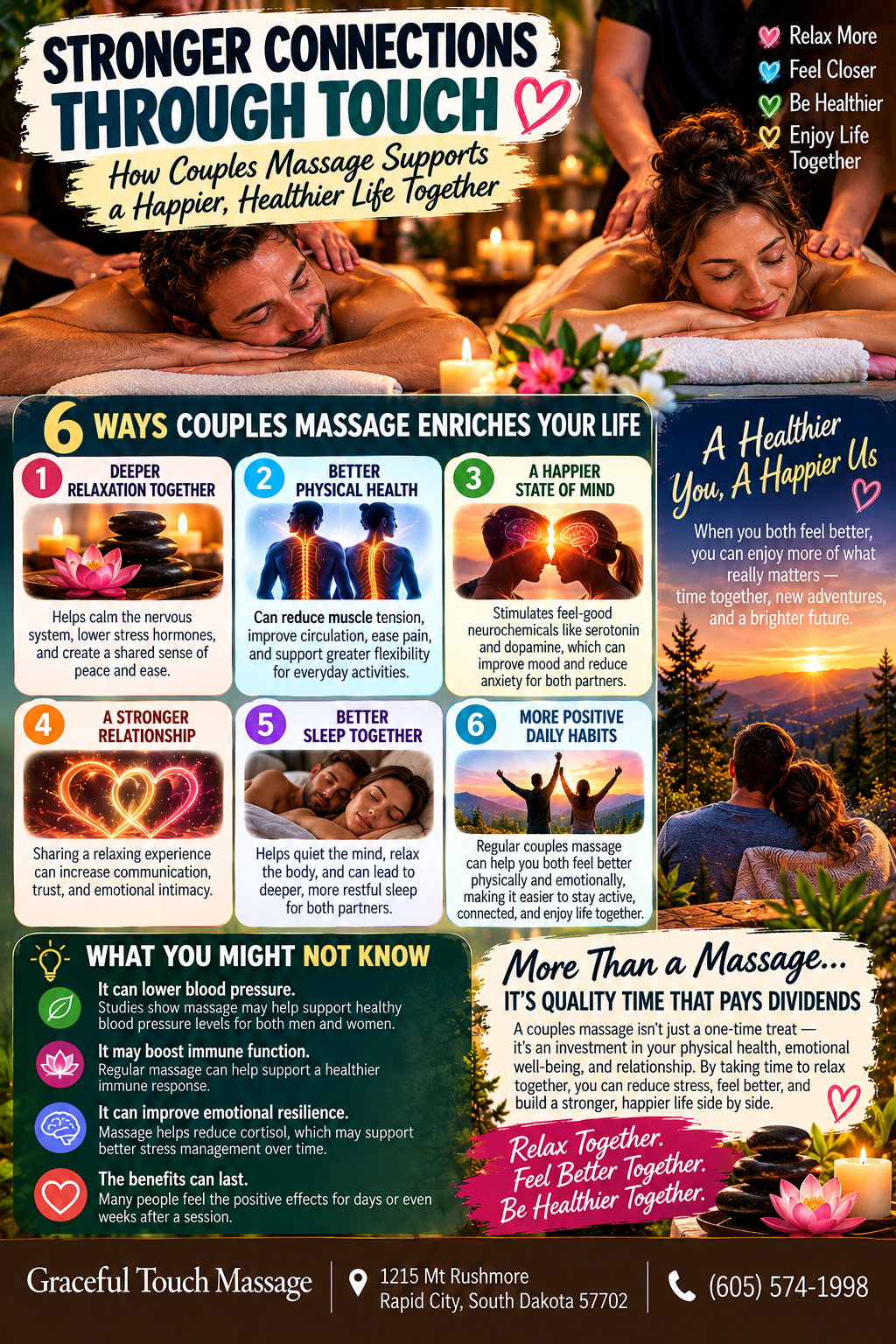
- Couples Massage Relaxation & Benefits: Why relaxation deserves to be valued as its own experience.
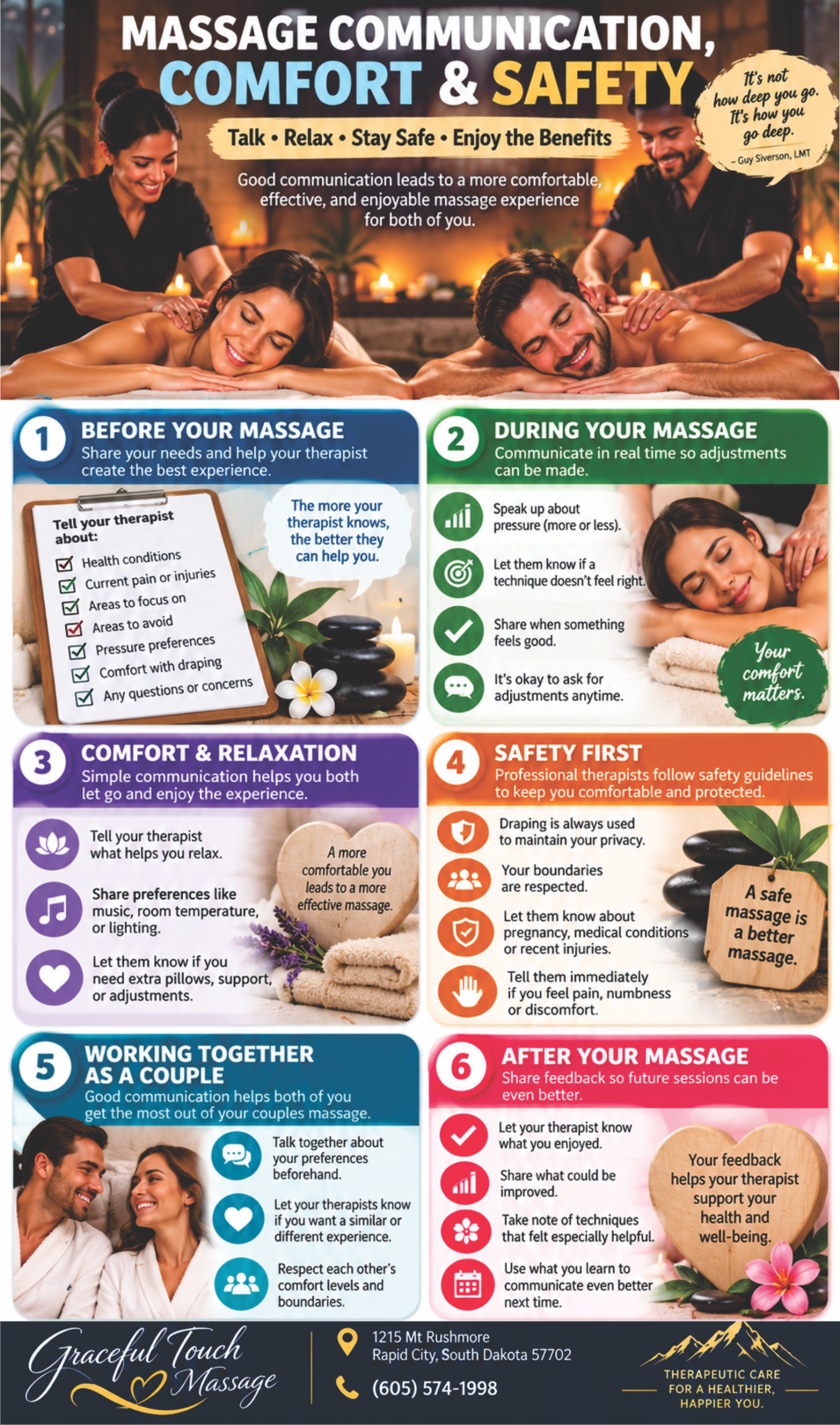
- Massage Communication, Comfort & Safety: How to communicate pressure preferences, boundaries, and personal goals.
- At-Home Couples Massage Techniques: Gentle, practical techniques for beginners.
- Professional vs. At-Home Couples Massage: The advantages and limitations of each option.
- Professional Couples Massage Experience: What makes professional care worthwhile, why I nearly left massage therapy, and how that experience led to Muscle Therapy.
- Couples Massage Booking, Prices & Packages: How to compare actual value rather than advertised prices.
- Couples Massage Near Me & Local Options: How to choose an appropriate provider, including options in Rapid City and the Black Hills.
You'll also discover the philosophy behind Muscle Therapy, my individualized approach combining deep tissue principles with targeted trigger point techniques.
My guiding principle is simple:
“It's not how deep you go. It's how you go deep.”
Couples Massage Relaxation & Benefits
Why Do People Choose Couples Massage?
People book couples massage for many reasons.
Some are celebrating an anniversary or another meaningful occasion. Others want time together away from work, responsibilities, and everyday distractions.
Some simply enjoy sharing a relaxing experience.
Whatever the occasion, a couples massage offers something increasingly valuable: time intentionally set aside for rest.
You don't need to accomplish anything during the appointment.
You don't need to solve a problem.
And you don't need to have a particular muscular complaint to justify receiving massage.
Sometimes the purpose is simply to enjoy the experience.
That is where understanding the distinction between relaxation massage and therapeutic massage becomes important.
Swedish Massage: The Value of a Genuine Chill Massage
In my practice, I describe Swedish relaxation massage as a chill massage.
That description reflects the experience I believe the service should provide.
A genuine chill massage is not primarily concerned with finding every muscle knot or correcting every area of tension.
Its purpose is to create an opportunity for relaxation.
The therapist uses comfortable, flowing techniques to support a peaceful experience.
The client can set aside the day's demands and simply enjoy receiving massage.
I sometimes describe the result as an emotional reset.
By that, I mean the personal experience of stepping away from stress and returning to everyday life feeling calmer and more settled—not a literal resetting of the nervous system.
This kind of relaxation has value in its own right.
Someone does not need to be injured, sore, or physically uncomfortable to appreciate a massage.
Why I Keep Swedish Relaxation and Therapeutic Massage Distinct
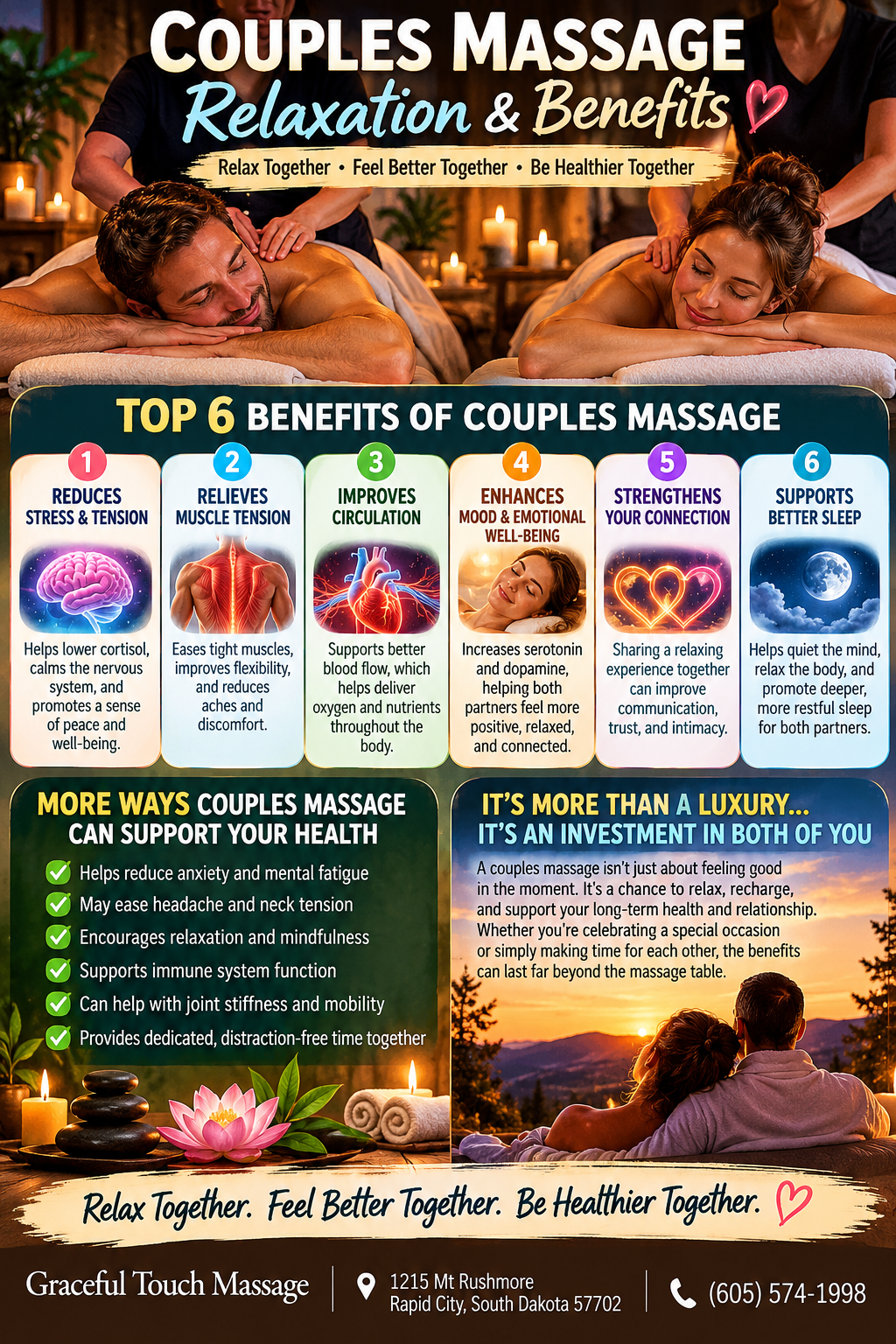
Swedish massage is a recognized collection of massage techniques. Those techniques can be used for different purposes.
However, I believe that a session specifically requested for relaxation should honor that purpose.
Some clients tell me that they have received appointments described as Swedish massage, only to discover that the therapist repeatedly shifted into focused work on tight or sensitive muscles.
The therapist may have believed they were providing additional benefits.
But the client wanted relaxation.
Those aren't necessarily the same thing.
A therapist can provide more techniques while delivering less of the experience the client actually wanted.
Imagine someone who has had a stressful week.
They book a Swedish massage because they want to relax.
During the appointment, the therapist discovers a tight area in the shoulders and begins applying increasingly concentrated pressure.
The client becomes uncomfortable.
Instead of enjoying a peaceful experience, they start wondering when the therapist will move on.
Even if the therapist believes the technique is useful, the session may no longer fulfill its original purpose.
That is why I believe relaxation massage deserves to remain a distinct experience.
The Emotional Value of Couples Massage
A couples massage can be meaningful because it allows two people to share an experience without competing demands on their attention.
The appointment may provide:
- A break from ordinary responsibilities.
- A peaceful environment.
- An opportunity to slow down.
- Individualized comfort.
- A positive shared memory.
- Time together without needing to perform a task.
These benefits don't depend on aggressive pressure.
They depend on how the experience feels to the people receiving it.
What Does Research Say About Massage and Relaxation?
Massage has been studied for outcomes such as pain, anxiety, and quality of life.
The National Center for Complementary and Integrative Health reports that massage may help with certain types of pain, although benefits are often short-term and the quality of research varies.
Evidence concerning anxiety is mixed and depends partly on the population studied.
These findings do not establish that massage cures emotional or medical conditions. They do suggest that massage may have a useful role in comfort and well-being for some individuals.
Research: NCCIH — Massage Therapy: What You Need to Know
It's also important to recognize that personal enjoyment and clinical outcomes are different measures.
A person may value a massage because they feel peaceful afterward, enjoyed the environment, or appreciated sharing the experience with someone else.
Those are legitimate reasons to receive massage even when no medical treatment is intended.
Can Relaxation Massage Include Moderate Pressure?
Yes.
Pressure preferences vary.
Some people enjoy very gentle contact. Others prefer a somewhat firmer sensation while still wanting a relaxing experience.
The distinction isn't simply light versus deep pressure.
It's the purpose of the appointment.
A chill massage should remain centered on relaxation rather than repeatedly shifting into concentrated therapeutic work without the client's agreement.
How Often Should Couples Receive Massage?
There is no universal schedule.
Some people enjoy couples massage for special occasions.
Others make it a recurring part of their wellness routine.
Frequency depends on personal preferences, finances, availability, and individual circumstances.
A massage every few weeks may appeal to one couple. Another may prefer an occasional appointment combined with gentle at-home relaxation.
Neither choice is automatically better.
The important thing is to choose an experience that remains enjoyable and sustainable.
The Relaxation Audit
Before booking, ask yourself:
- Do I want to relax, or do I want specific muscular concerns addressed?
- Have previous painful massages influenced my preferences?
- Do I want the therapist to avoid focused treatment today?
- Would I enjoy quiet, conversation, or a combination?
- What would make this experience worth remembering?
Professional insight: A person who wants relaxation should receive genuine relaxation—not a therapeutic session disguised under a Swedish massage label.
Try this: When booking, say: “My priority is a peaceful Swedish relaxation massage. I don't want concentrated deep tissue work unless we discuss it first.”
Continue learning: Explore our dedicated Couples Massage Relaxation & Benefits article for a deeper look at relaxation goals, shared experiences, and how to choose the right type of massage.
Massage Communication, Comfort & Safety
The Question That Can Change Your Entire Massage Experience
Many therapists ask clients whether they prefer light, medium, or deep pressure.
That information matters.
But I believe another question should come first:
“What do you want this massage experience to accomplish?”
Consider two people who request Swedish massage.
The first wants to relax.
The second has significant muscular tension but previously received a painful deep tissue massage. They request Swedish massage because they don't want to repeat that experience.
Both have selected the same service.
But their motivations are different.
The first person may genuinely want a chill massage.
The second may appreciate focused therapeutic work if they understand that it doesn't necessarily have to involve painful pressure.
Without asking why someone selected a service, a therapist can easily misunderstand what the client needs.
Why People Sometimes Fear Deep Tissue Massage
Some clients have experienced aggressive deep tissue massage that involved substantial discomfort during treatment.
Others describe feeling sore for several days afterward.
When they eventually experience relief, they may conclude that the discomfort was a necessary part of the process.
That belief can influence their future choices.
Someone planning a couples massage may decide that relaxation massage is the safest option because they don't want the occasion overshadowed by pain.
I understand that concern.
In fact, my own painful experience with traditional deep tissue massage almost convinced me not to enter the profession.
But I challenge the assumption behind it.
Focused therapeutic massage does not inherently require unnecessary pain.
Deep Tissue Massage Is Not a Test of Pain Tolerance
Deep tissue massage involves focused work intended to address deeper muscular structures.
It is not formally defined by how much pain the client experiences.
Nevertheless, some people have encountered a force-driven approach where intense pressure is treated as essential.
I disagree with making pain the measure of successful treatment.
If a person is bracing, holding their breath, or enduring pressure they don't want, the therapist should reconsider the technique.
The objective should be appropriate care—not demonstrating how much force the client can tolerate.
Seven Conversations to Have Before a Massage
1. Explain your goal.
Tell the therapist whether you want relaxation, focused therapeutic attention, or both.
2. Discuss previous experiences.
If you've had painful massages, explain what happened.
3. Identify your priority areas.
Mention any areas of muscular tension you would like addressed.
4. Establish boundaries.
Tell the therapist which areas you do not want massaged.
5. Explain your pressure preferences.
Describe what feels comfortable rather than relying only on labels such as light or deep.
6. Share relevant health information.
Mention injuries, recent procedures, pregnancy, medical conditions, or changes in sensation that may affect the session.
7. Define success.
Tell the therapist what would make you feel satisfied when the appointment ends.
The Difference Between Productive Communication and Enduring Discomfort
Some clients hesitate to speak up because they assume the therapist knows best.
But the therapist cannot directly experience what the client feels.
Your feedback is essential.
A useful communication system is:
“That's comfortable.” Continue.
“Could you use a little less pressure?” Adjust.
“That area feels sensitive.” Reassess.
“Please stop that technique.” Stop.
You do not need to apologize for asking the therapist to change something.
Why Comfort Includes More Than Pressure
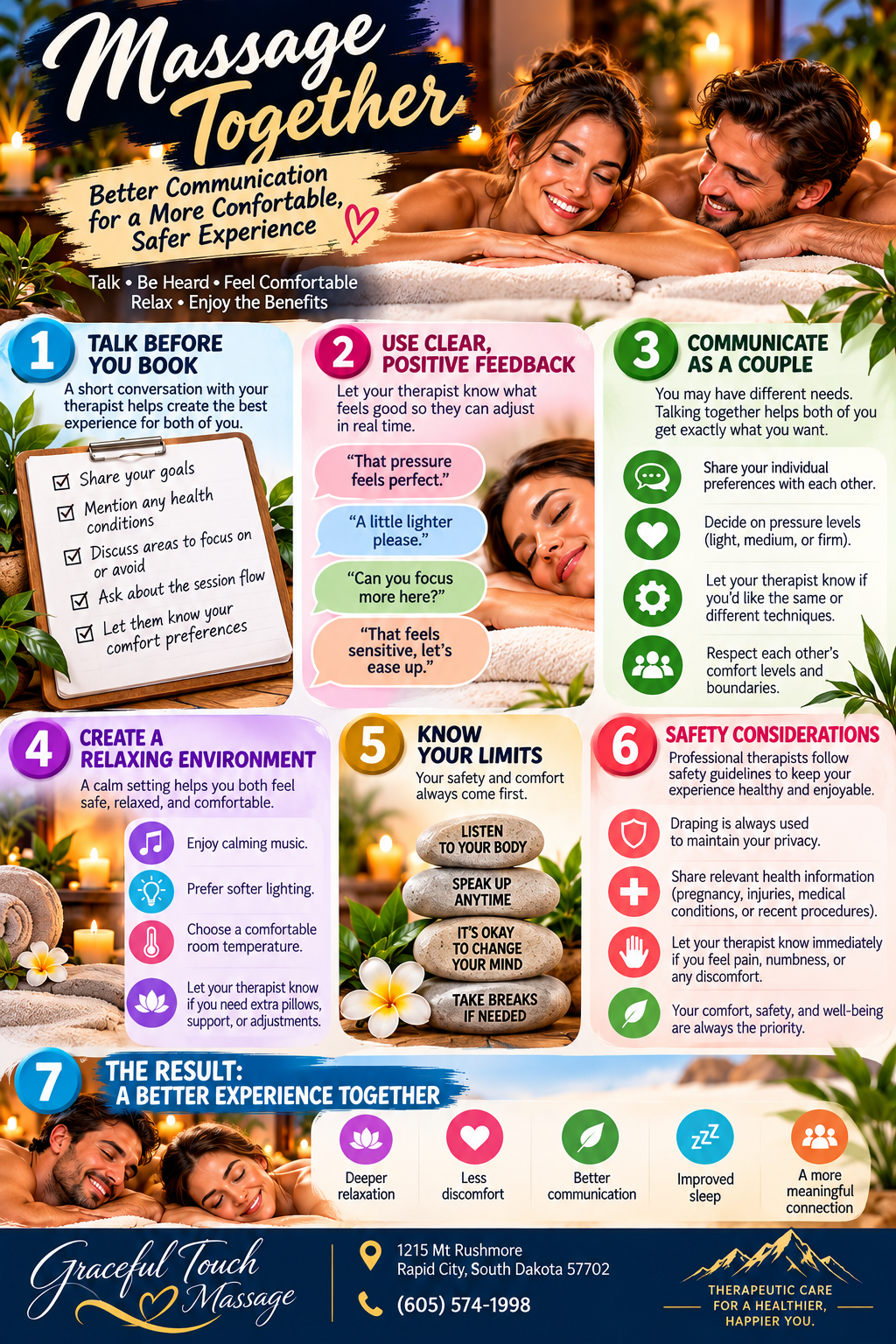
A professional massage should also account for:
- Room temperature.
- Appropriate draping and privacy.
- Comfortable positioning.
- Mobility limitations.
- Clear explanations.
- Respect for consent.
- Sensory preferences.
- The ability to request changes.
A client who cannot comfortably lie face down may need an alternative position.
A person with sensitive joints may need additional support.
Someone with reduced sensation may require a different approach or medical guidance.
Comfort should be individualized.
When Massage May Need to Be Modified or Avoided
Certain conditions require extra care.
Examples include suspected blood clots, infections, recent surgery, significant osteoporosis, unexplained swelling, acute injuries, and some pregnancy-related complications.
Clients with neuropathy or reduced sensation may not be able to judge pressure reliably.
Massage should not be used to diagnose unexplained symptoms or postpone necessary medical evaluation.
If you're uncertain whether massage is appropriate for a medical condition, consult a qualified healthcare professional.
Why Couples Massage Requires Two Separate Consultations
A shared appointment does not eliminate individual needs.
One person may want quiet relaxation.
The other may want focused muscular attention.
One may prefer moderate pressure.
The other may want gentle contact.
Each participant should have the opportunity to communicate independently.
That is especially important when one person has had uncomfortable massage experiences in the past.
The Hidden Value of Saying “Not Today”
Suppose someone usually enjoys focused therapeutic work but books a couples massage for a special occasion.
They may simply want to relax.
They should feel comfortable telling the therapist:
“I normally enjoy therapeutic massage, but today I want a chill massage.”
Likewise, someone who normally books Swedish massage may want to explore focused treatment after learning that it doesn't necessarily have to hurt.
Preferences can change from one appointment to another.
The therapist's responsibility is to respect the current goal.
Professional insight: Communication isn't just about pressure. It's about understanding why the person came and what kind of experience they want.
Try this: Before your next massage, write one sentence beginning, “When this appointment is over, I would like to feel…” Share it with your therapist.
Continue learning: Our Massage Communication, Comfort & Safety guide explores pressure preferences, boundaries, positioning, and how to speak up confidently.
At-Home Couples Massage Techniques
Can You Create a Meaningful Couples Massage at Home?
Yes.
An enjoyable at-home massage doesn't require expensive equipment or advanced techniques.
It requires communication, comfortable positioning, and a willingness to keep things simple.
At-home massage can be a wonderful way to share relaxation.
But it should not be confused with professional therapeutic treatment.
For beginners, the goal should generally be comfort and enjoyment rather than trying to reproduce deep tissue or trigger point work.
The First At-Home Massage Secret: Don't Try to Fix Everything
One of the most common mistakes people make when giving massage is trying to accomplish too much.
They notice a tight shoulder and immediately want to work harder.
They discover a tender area and assume it needs concentrated pressure.
But if the recipient simply wants to relax, this may be the wrong approach.
Remember the purpose of a chill massage.
Sometimes the greatest value comes from providing a peaceful experience without trying to correct every physical complaint.
Create the Right Environment
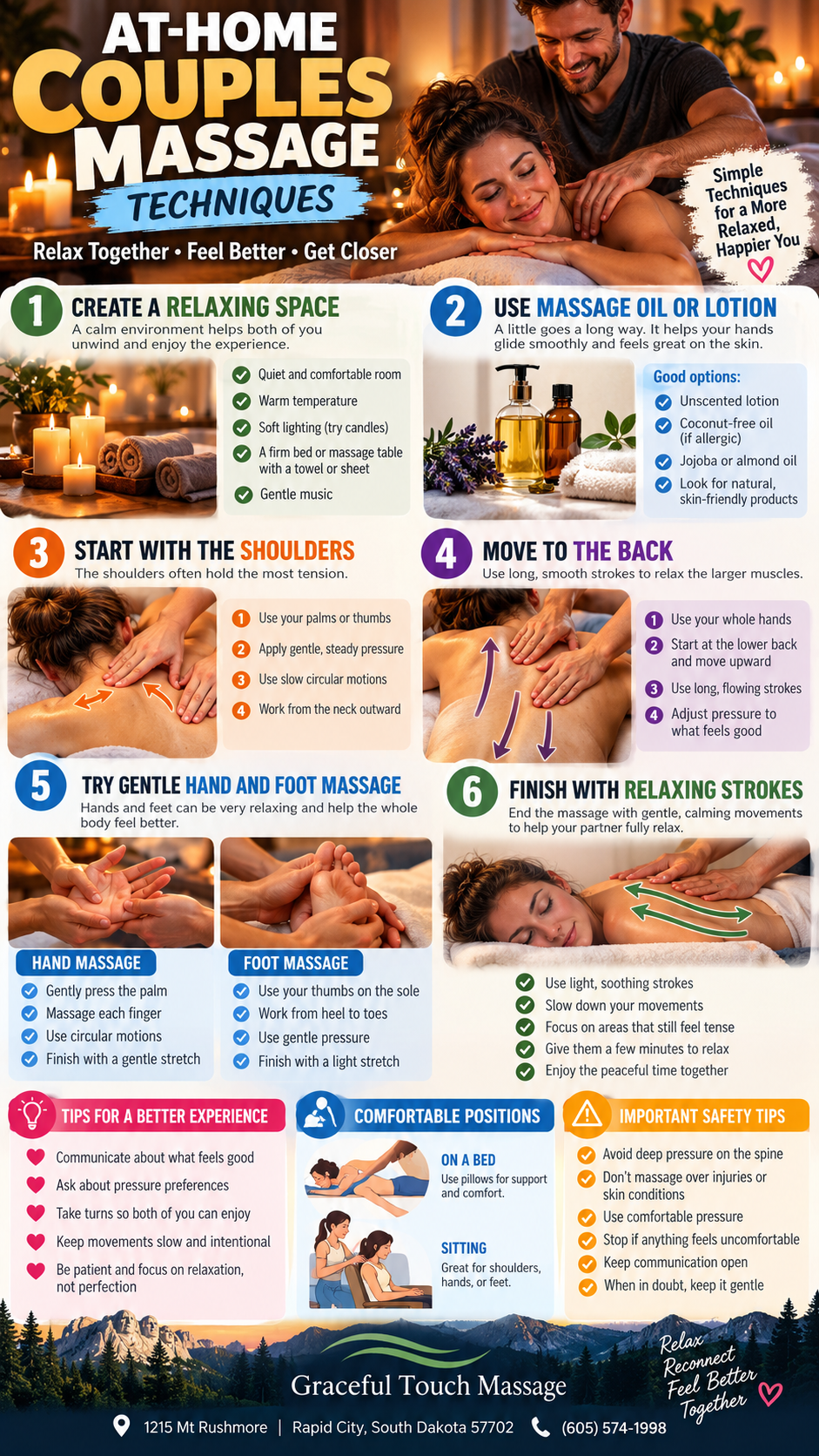
Choose a comfortable, supportive location.
A chair with back support can work well for gentle shoulder or hand massage.
A stable sofa may also be appropriate for simple techniques.
Consider:
- A comfortable room temperature.
- Soft lighting.
- Quiet music if desired.
- Clean hands.
- Supportive cushions.
- Clothing that allows comfortable, noninvasive contact.
- Enough space for the person giving massage to avoid awkward posture.
You do not need a professional massage table to enjoy gentle relaxation techniques.
Technique 1: Gentle Shoulder Massage
Have the recipient sit comfortably with their back supported.
Place your hands gently on the muscular portions of the upper shoulders.
Use slow, comfortable movements.
Avoid direct pressure on the spine or sensitive structures of the neck.
Ask how the contact feels.
Don't assume that greater pressure will make the technique more effective.
Technique 2: Relaxing Hand Massage
Hand massage is particularly convenient because both people can remain seated.
Support the recipient's hand.
Use gentle movements across the palm and fleshy portions of the hand.
Avoid forcing finger joints or stretching them aggressively.
Ask which movements feel most comfortable.
For many people, the simplicity of hand massage is part of its appeal.
Technique 3: Forearm Relaxation
With the arm comfortably supported, use gentle strokes over the muscular portions of the forearm.
Avoid excessive pressure.
Stop if the recipient experiences tingling, numbness, or discomfort.
This is intended as a relaxing experience, not treatment for a repetitive strain injury.
Technique 4: Gentle Foot Massage
Support the foot comfortably.
Use light, smooth movements across the sole.
Avoid aggressive pressure on sensitive areas.
Do not massage areas with wounds, infection, or unexplained swelling. Certain circulatory or neurological conditions may make foot massage inappropriate without medical guidance.
Technique 5: Upper-Back Relaxation
With the recipient comfortably positioned, use broad, gentle strokes over the upper-back muscles.
Avoid pressing directly on the spine.
Focus on comfortable, predictable movements.
The goal is relaxation rather than attempting to locate and release every tender area.
Technique 6: Comfortable Still Contact
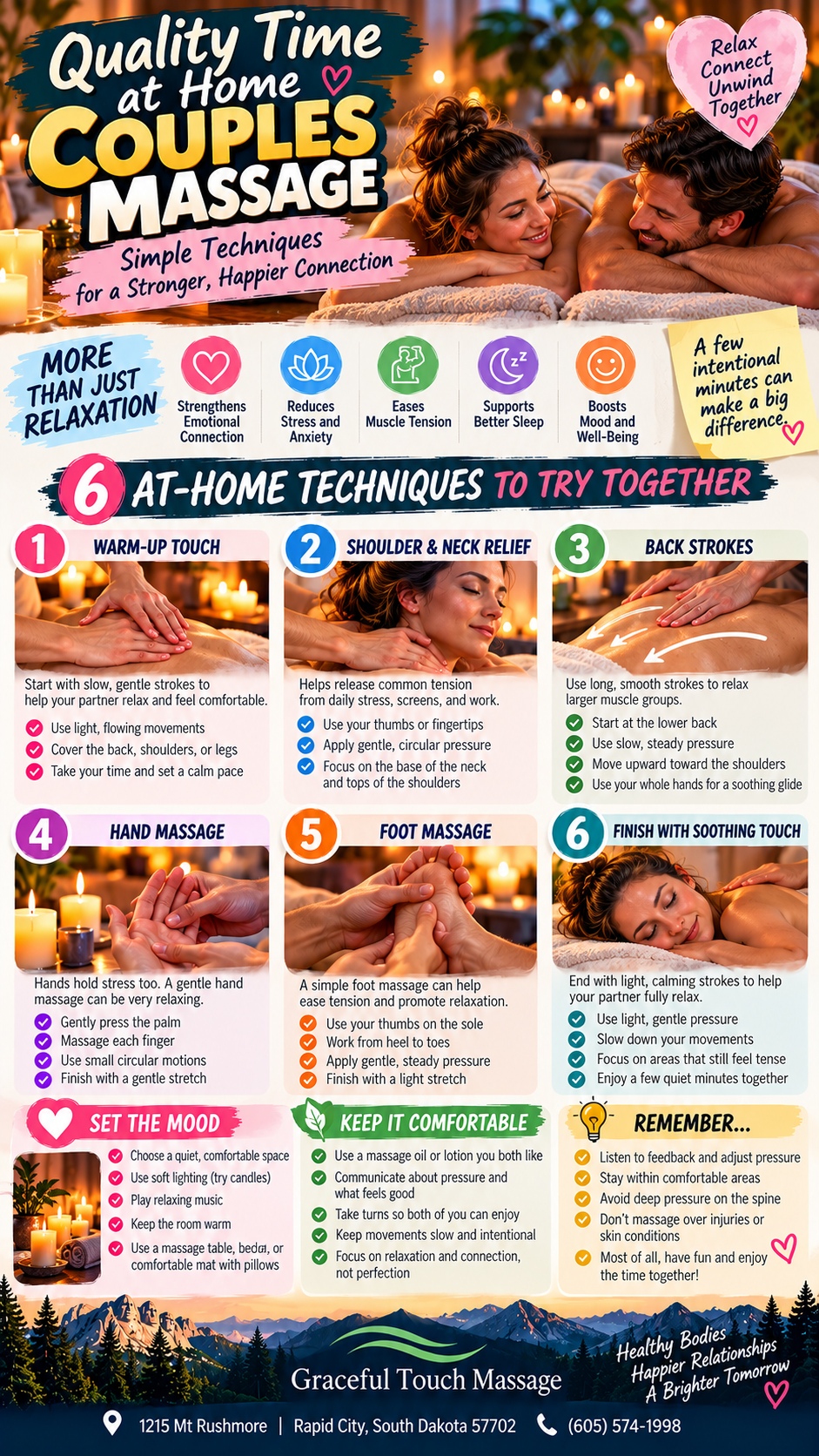
With permission, simply resting your hands gently on the upper shoulders or back can create a peaceful moment.
There is no requirement to perform continuous movements.
For some people, quiet and comfortable contact may be more enjoyable than a complicated sequence.
A Simple 20-Minute Couples Massage Routine
Minutes 1–3: Prepare.
Ask what the recipient wants, identify areas to avoid, and establish comfortable positioning.
Minutes 4–7: Shoulders.
Use gentle, unhurried movements.
Minutes 8–11: Hands.
Support the hands and use light palm massage.
Minutes 12–15: Forearms or feet.
Let the recipient choose.
Minutes 16–18: Return to the favorite area.
Repeat the technique the recipient enjoyed most.
Minutes 19–20: Finish gently.
Slow down and ask how the experience felt.
Switch roles if both people wish.
You don't need to complete every step.
What Beginners Should Avoid
Avoid aggressive pressure, forceful neck movements, direct pressure over the spine, or attempting to treat painful conditions through unfamiliar techniques.
Do not try to reproduce professional trigger point treatment without appropriate training.
Stop when a technique causes pain, tingling, numbness, or other unwanted sensations.
The Second At-Home Secret: Let the Recipient Guide the Experience
The person giving massage may want to demonstrate skill.
But the recipient's comfort matters more.
Ask:
“Would you like more of this, less pressure, or something different?”
That simple question can improve the experience immediately.
The Third At-Home Secret: Consistency Often Matters More Than Variety
You don't need six different techniques.
If the recipient enjoys gentle hand massage, spending ten comfortable minutes on the hands may be better than constantly switching between techniques.
The goal is not to complete a checklist.
It's to create an enjoyable experience.
When Professional Massage Makes More Sense
If someone has persistent pain, significant muscular discomfort, or concerns requiring trained judgment, professional care may be more appropriate.
Massage also isn't a substitute for medical assessment when symptoms are unexplained, worsening, or severe.
Professional insight: The most successful beginner massage is often the simplest one. Comfort and communication matter more than complexity.
Try this: Give five minutes of gentle hand massage while asking for feedback. Notice how much can be accomplished without advanced techniques.
Continue learning: Our At-Home Couples Massage Techniques article explores beginner-friendly ways to create a relaxing shared experience.
Professional vs. At-Home Couples Massage
Which Is Better: Professional Massage or Massage at Home?
Both can be valuable.
But they serve different purposes.
At-home massage offers convenience, shared participation, and simple relaxation.
Professional massage offers trained practitioners, specialized techniques, appropriate equipment, and the ability to tailor a session to individual goals.
The best choice depends on what you're trying to accomplish.
What At-Home Massage Does Best
At-home massage is particularly useful when you want:
- A simple shared activity.
- A convenient way to relax.
- A low-cost experience.
- Gentle contact without specialized techniques.
- Flexibility in timing and location.
It can be a pleasant addition to everyday life.
You don't need to transform it into a professional-style treatment for it to be worthwhile.
What Professional Massage Adds
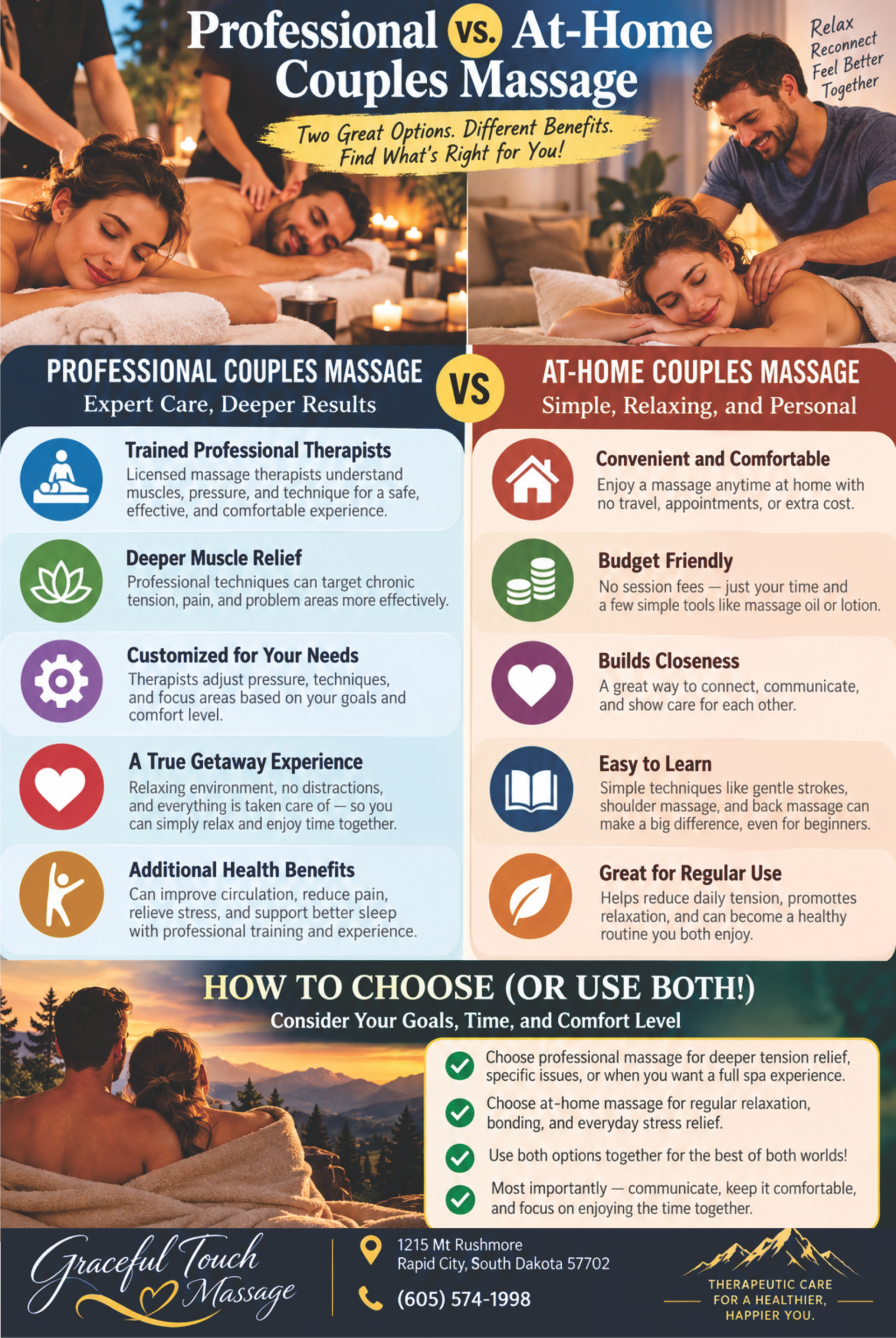
A qualified massage therapist brings training and practical experience.
Professional massage may offer:
- More informed technique selection.
- Appropriate positioning and support.
- Recognition of situations requiring precautions.
- Focused work within the therapist's training.
- Adaptation to different pressure preferences.
- A dedicated environment where neither participant needs to perform the massage.
For couples, that last point can make a significant difference.
When both people receive massage from professionals, each can concentrate on enjoying the appointment.
The Professional Advantage Isn't Simply More Pressure
People sometimes assume professional massage is better because the therapist can apply stronger pressure.
But that misses the point.
A professional therapist's value should include judgment.
Knowing when to use a technique matters.
Knowing when to reduce pressure matters.
Knowing when to preserve a relaxation experience matters.
And knowing when a concern requires medical attention rather than massage matters.
Professionalism isn't measured by force. It's demonstrated through appropriate decisions.
Comparing the Two Experiences
| Consideration | At-Home Couples Massage | Professional Couples Massage |
|---|---|---|
| Primary advantage | Convenience and shared relaxation | Trained, individualized care |
| Cost | Usually lower | Professional appointment fee |
| Techniques | Gentle beginner methods | Broader range within therapist training |
| Equipment | Household supports | Professional massage equipment |
| Focused therapeutic work | Not appropriate for untrained beginners | May be appropriate |
| Shared experience | Often involves taking turns | May allow simultaneous massage |
| Scheduling | Flexible | Appointment required |
| Individual customization | Based on simple preferences | May include specialized techniques and positioning |
Why One Person May Want Swedish Massage While the Other Wants Deep Tissue
This is a common planning challenge.
One participant may want a chill massage.
The other may have persistent shoulder tension and want focused attention.
Some people assume both must select the same service because they're booking together.
But a couples massage can be a shared experience without requiring identical treatments.
The business must be able to accommodate the requests, and each person should understand what they're receiving.
The Overlooked Problem With Painful Deep Tissue Experiences
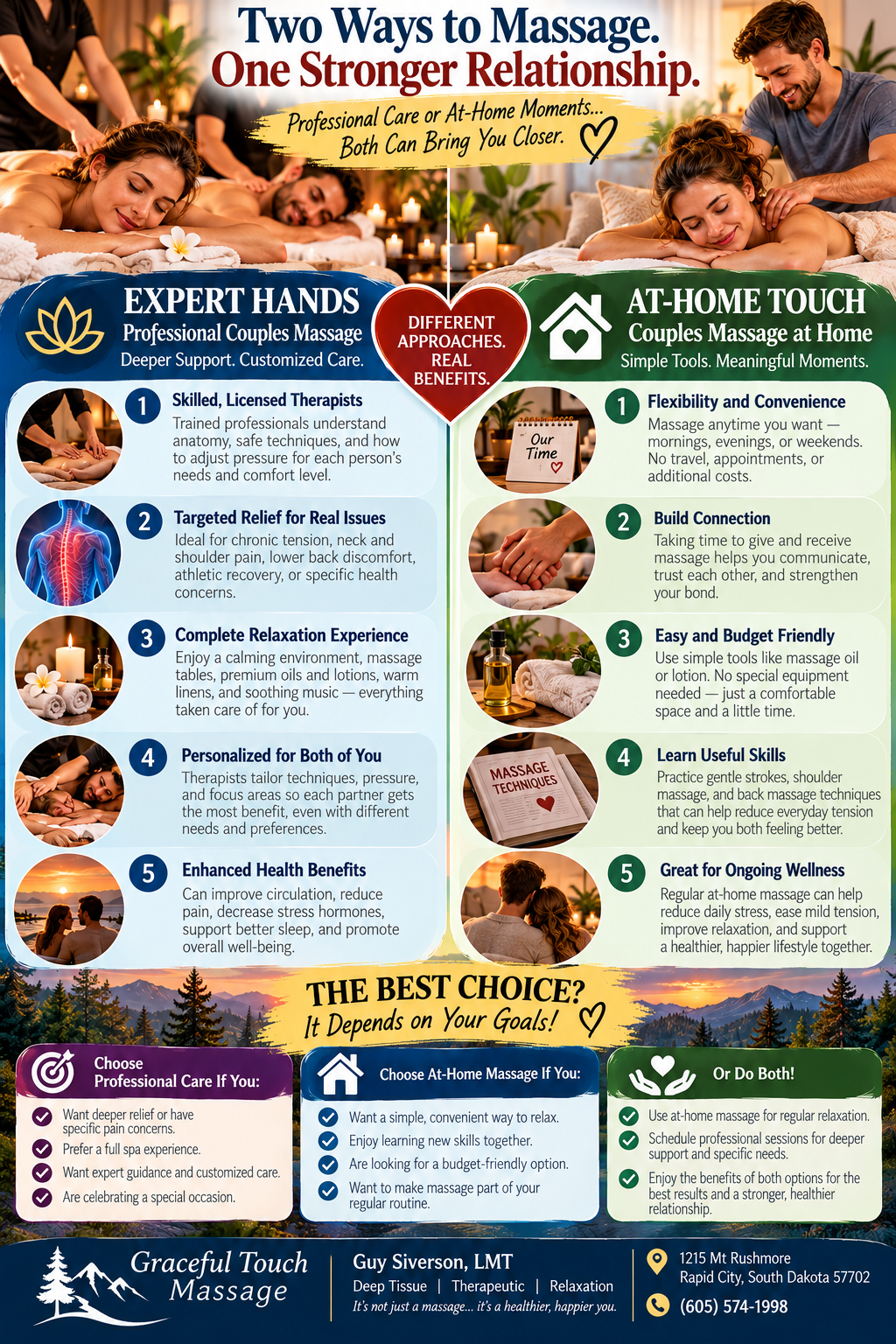
A person who previously received an aggressive deep tissue massage may avoid professional therapeutic work entirely.
They may believe that relaxation massage is the only comfortable option.
But professional therapeutic massage can be approached differently.
Thoughtful technique selection, individualized pressure, and targeted work may provide an experience that feels very different from the painful sessions they remember.
This is where understanding the therapist's philosophy becomes especially important.
When to Choose At-Home Massage
Choose at-home massage when your main goals are convenience, shared time, and gentle relaxation.
Keep the techniques simple.
Avoid attempting to treat persistent pain.
When to Choose Professional Couples Massage
Consider professional massage when you want individualized attention, trained practitioners, specialized positioning, or a shared appointment where both people receive care.
It's also worth considering when one participant wants focused therapeutic work while the other wants relaxation.
Why the Best Choice May Be Both
You don't necessarily have to choose one forever.
Professional massage may be valuable for certain goals or special occasions.
At-home massage can provide a simple way to enjoy relaxation between appointments.
Each has strengths.
The important thing is understanding those strengths rather than expecting one experience to do everything.
A Practical Decision Exercise
Ask yourselves three questions:
First: Are we primarily seeking relaxation, focused care, or both?
Second: Do we want to give each other massage, or would we prefer to receive it from professionals?
Third: Does either person have needs that require trained attention or additional precautions?
Your answers will help determine the better choice.
Professional insight: A shared couples massage experience should accommodate individual differences whenever possible. Two people can enjoy the same occasion for different reasons.
Try this: Each participant should independently identify their ideal massage experience before comparing options together.
Continue learning: Our Professional vs. At-Home Couples Massage guide explains the practical differences and when each approach offers the greatest value.
Professional Couples Massage Experience
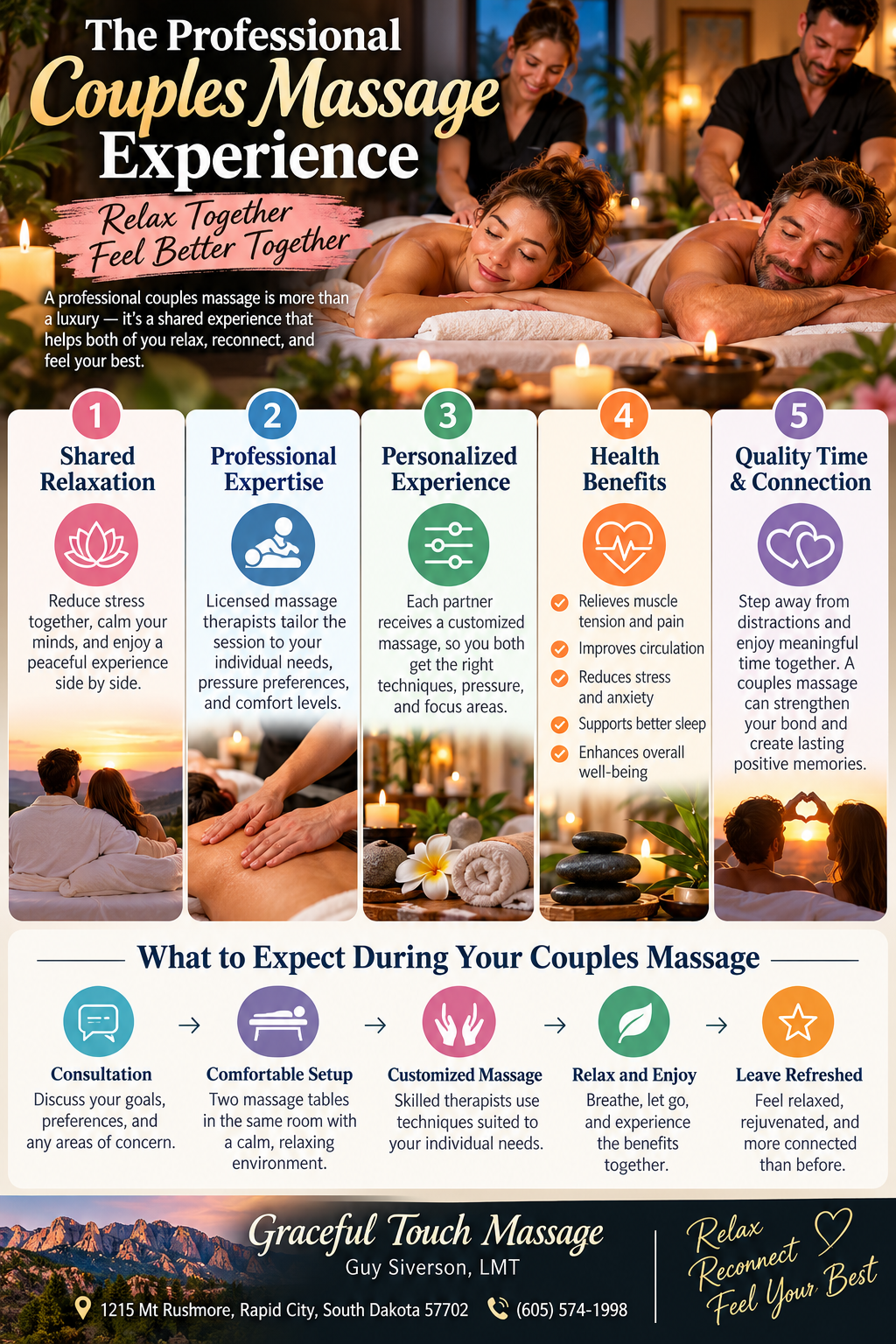
What Makes a Professional Couples Massage Truly Professional?
A professional massage experience involves more than attractive surroundings and a long menu of services.
The quality of the experience depends heavily on the therapist's ability to understand the client.
What does the person want?
What have they experienced before?
What techniques are appropriate?
What would make the appointment successful?
For me, these questions are central to massage.
But my philosophy didn't begin as a marketing concept.
It began with an experience that nearly convinced me not to become a massage therapist at all.
Why I Almost Walked Away From Becoming a Massage Therapist
I almost didn't become a massage therapist.
During my massage therapy education, I personally experienced the kind of traditional deep tissue massage that convinced me something was wrong with the way this work was being taught.
The pressure was painful, and I questioned why that level of discomfort should be necessary.
But I had another concern.
I believed that repeatedly performing this kind of forceful massage placed unnecessary physical demands on the therapist as well.
Why should we be teaching techniques that cause unnecessary pain to clients while potentially shortening the working careers of the very people providing the care?
When I raised these concerns with my deep tissue massage instructor, I was told that I would have to perform the work that way because that was how the technique was being taught.
My response was firm.
I would take the tests. I would pass the class. But I would not practice massage in a way that I believed caused unnecessary harm.
I was entering a profession dedicated to helping people.
I believed that commitment carried a responsibility to avoid causing unnecessary pain.
If the only way to provide effective deep tissue massage was to hurt my clients, I wasn't sure I wanted to become a massage therapist.
But instead of walking away, I began questioning the assumption itself.
What if deep tissue massage didn't have to hurt?
What if the answer wasn't applying more force, but understanding how to work with the muscles more effectively?
What if a therapist could provide focused attention to muscular tension without making the client endure an unnecessarily painful experience?
And what if doing so could also reduce the physical strain placed on the therapist?
Those questions helped shape the approach I eventually came to call Muscle Therapy.
Why Therapist Longevity Matters Too
Massage is physically demanding work.
A therapist who relies heavily on muscular force may place substantial demands on their hands, wrists, shoulders, and back.
Body mechanics, technique selection, pacing, and workload all influence how demanding the work becomes.
I believe therapists should be taught to work effectively without relying unnecessarily on force.
That concern is not only about the therapist.
It also matters to the client.
When therapists develop efficient techniques, they may be better able to provide consistent, individualized care without treating excessive pressure as the primary tool.
My experience led me to question a philosophy that I believed could be unnecessarily hard on both sides of the massage table.
That conviction became part of the foundation of my work.
Three Experiences That Shouldn't Be Confused
I believe it's important to distinguish among three approaches.
Swedish Relaxation: The Chill Massage
This is a relaxation-centered experience.
Its purpose is to give the client an opportunity to unwind, feel comfortable, and enjoy a peaceful appointment.
It shouldn't automatically become a concentrated muscular treatment.
Traditional Deep Tissue Massage
Deep tissue massage involves focused techniques intended to address deeper muscular structures.
Many clients have experienced aggressive forms of this work and have come to associate deep tissue massage with pain.
Some describe discomfort during the appointment followed by days of soreness.
Not every deep tissue therapist works that way.
But these experiences are important because they influence what people expect.
I know that personally because my own experience with a forceful approach nearly changed the course of my career.
Muscle Therapy: My Individualized Approach
I call my approach Muscle Therapy.
It combines deep tissue principles with targeted trigger point techniques.
The emphasis is on identifying areas that may benefit from focused attention, choosing appropriate techniques, and adjusting the work to the client's response.
Rather than relying primarily on increasingly aggressive pressure, I emphasize precision and comfort.
Muscle Therapy is the name I use for my approach. It is not a separate state-recognized massage license or a universally established clinical classification.
Why I Believe Deep Tissue and Trigger Point Techniques Belong Together
In my practice, deep tissue and trigger point techniques can complement one another.
Deep tissue work offers one way to address muscular structures and patterns of tension.
Trigger point techniques offer a more localized approach to areas of tenderness.
I believe the value comes from integrating techniques thoughtfully rather than treating any single method as the answer to every problem.
That does not mean more techniques automatically produce better results.
The important questions are:
Where should the therapist work?
What technique is appropriate?
How does the client respond?
Can the work remain comfortable?
And when should the therapist change course?
Precision Instead of Force
Imagine someone arrives with significant shoulder tension.
A force-driven approach might involve repeatedly increasing pressure.
My preferred approach is different.
I want to understand where the discomfort is occurring and how the person responds to focused work.
Sometimes that means changing techniques rather than increasing force.
Sometimes it means spending more time with a particular area.
Sometimes it means reducing pressure.
The goal is to provide appropriate attention while respecting comfort.
Deeper is not automatically better. More painful is not automatically more effective.
What Clients Have Told Me
Over the years, numerous clients have told me that my Muscle Therapy approach feels unlike massages they've received elsewhere.
Some have made that observation despite having received hundreds of massages.
Others have reported that the relief they experienced lasted longer than what they were accustomed to from previous massage treatments.
These comments are meaningful parts of my professional experience.
They are client reports, not controlled clinical comparisons.
They don't establish that Muscle Therapy is scientifically superior or that everyone will experience the same outcome.
But they help explain why I continue to emphasize individualized, targeted care.
Why Immediate Comfort Matters to Me
People usually seek therapeutic massage because they want to feel better.
I question the philosophy that someone must endure substantial pain during treatment and then wait several days before experiencing relief.
Temporary soreness can occur after massage.
But significant soreness shouldn't be treated as a necessary sign of effectiveness.
My goal is to help clients experience greater comfort as soon as reasonably possible.
That doesn't mean every condition can be resolved immediately.
Some concerns are complex.
Some people respond differently.
Others may need additional care beyond massage.
Nevertheless, I believe the therapist should work toward relief rather than making pain the centerpiece of the experience.
What Research Says About Targeted Manual Therapy
The research on massage and trigger point techniques is more complicated than marketing claims sometimes suggest.
A 2019 systematic review of trigger point manual therapy for chronic noncancer pain examined 19 trials involving 1,047 participants. It found weak overall evidence for pain relief, although some outcomes suggested possible improvements in function or patient-reported response.
A 2022 network meta-analysis examining different manual therapy interventions for myofascial trigger points found promising results for certain combined approaches. However, those findings do not directly establish that my particular Muscle Therapy method is superior to other massage approaches.
Research also shows inconsistency in how trigger points are identified across studies, which complicates comparisons.
Read the diagnostic criteria review on PubMed.
These findings reinforce the importance of distinguishing professional experience from scientific proof.
My approach is grounded in my practical philosophy and client experiences. It should not be presented as a guaranteed medical treatment.
The Importance of Matching the Experience to the Client
Consider a couple booking an appointment.
One person wants a chill massage.
The other wants focused attention to muscular tension.
The first person should be able to relax without unwanted concentrated treatment.
The second should be able to discuss therapeutic options without assuming that pain is unavoidable.
The therapists should understand both goals.
That is what makes individualized care meaningful.
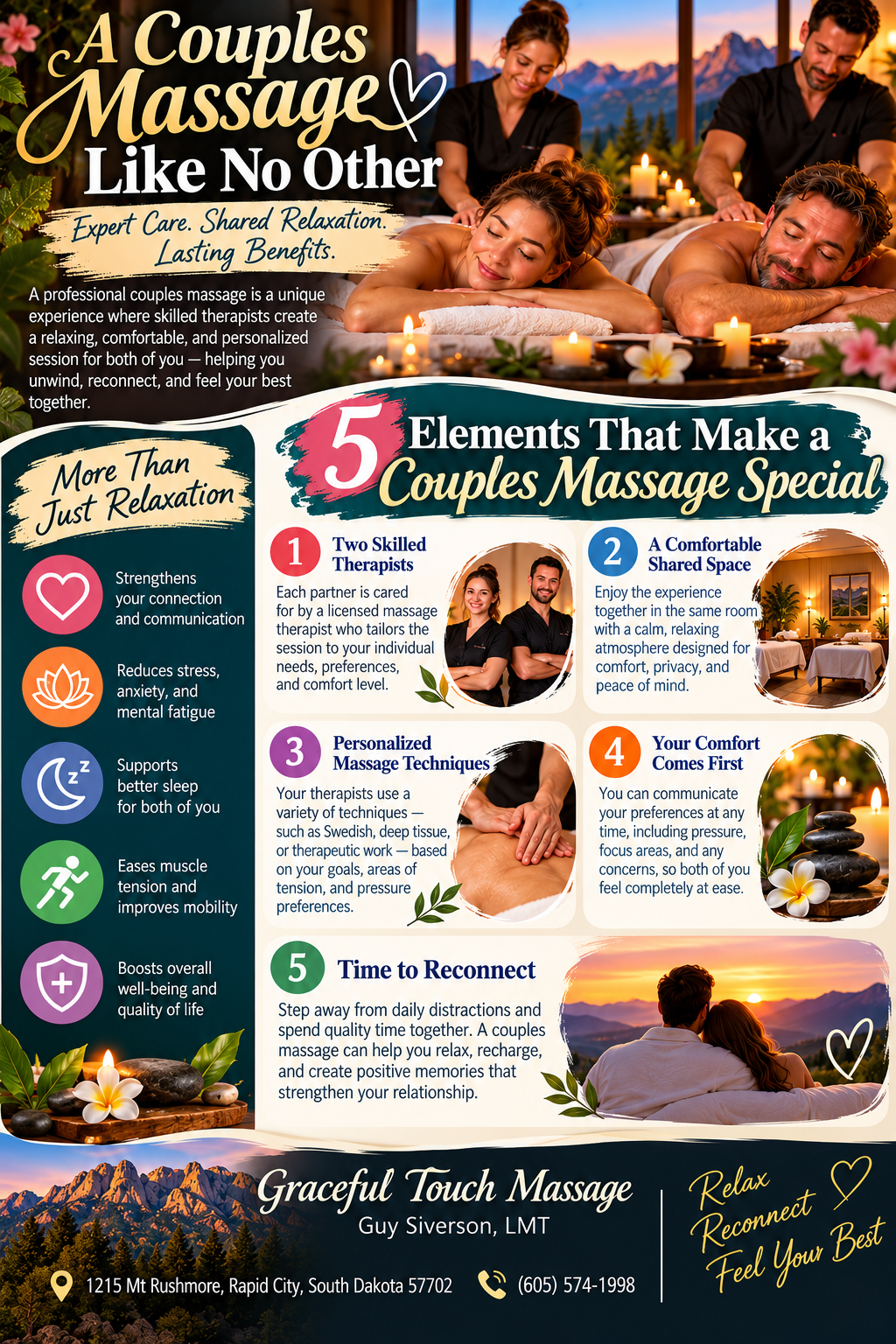
What to Expect During a Professional Couples Massage
A typical appointment may include:
Booking: Choose services and confirm availability, pricing, and room arrangements.
Arrival: Complete any required intake information.
Consultation: Discuss goals, health considerations, and pressure preferences.
Preparation: Review positioning, clothing, draping, and communication.
Massage: Receive the agreed-upon service, with adjustments as needed.
Afterward: Discuss your experience and ask any questions.
Procedures vary by business, so confirm the details before arriving.
First-Time Couples Massage Preference Worksheet
Each participant can complete this independently.
Person One
- My main goal:
- I prefer relaxation, therapeutic work, or both:
- My comfortable pressure preference:
- Areas where I would welcome attention:
- Areas I want avoided:
- Relevant health or positioning considerations:
- What I want to feel when the appointment ends:
Person Two
- My main goal:
- I prefer relaxation, therapeutic work, or both:
- My comfortable pressure preference:
- Areas where I would welcome attention:
- Areas I want avoided:
- Relevant health or positioning considerations:
- What I want to feel when the appointment ends:
Bring these preferences to your appointment.
The Memory Should Be Part of the Treatment Plan
Two people may receive excellent technical massage yet have very different experiences.
One may feel comfortable and relaxed.
The other may spend the appointment enduring unwanted pressure.
That is not the shared memory they intended to create.
A good couples massage should respect both individuals.
Professional insight: The quality of massage isn't measured by the number of techniques performed or the amount of pressure applied. It's measured by how appropriately the therapist serves the client's goals.
Try this: Ask the provider, “Can one of us receive a genuine Swedish relaxation massage while the other receives focused therapeutic work?”
Planning a couples massage in Rapid City? Contact Graceful Touch Massage at (605) 574-1998 to discuss your individual preferences and available services.
Continue learning: Our Professional Couples Massage Experience guide explains therapist selection, expectations, individualized care, and what makes a massage appointment worthwhile.
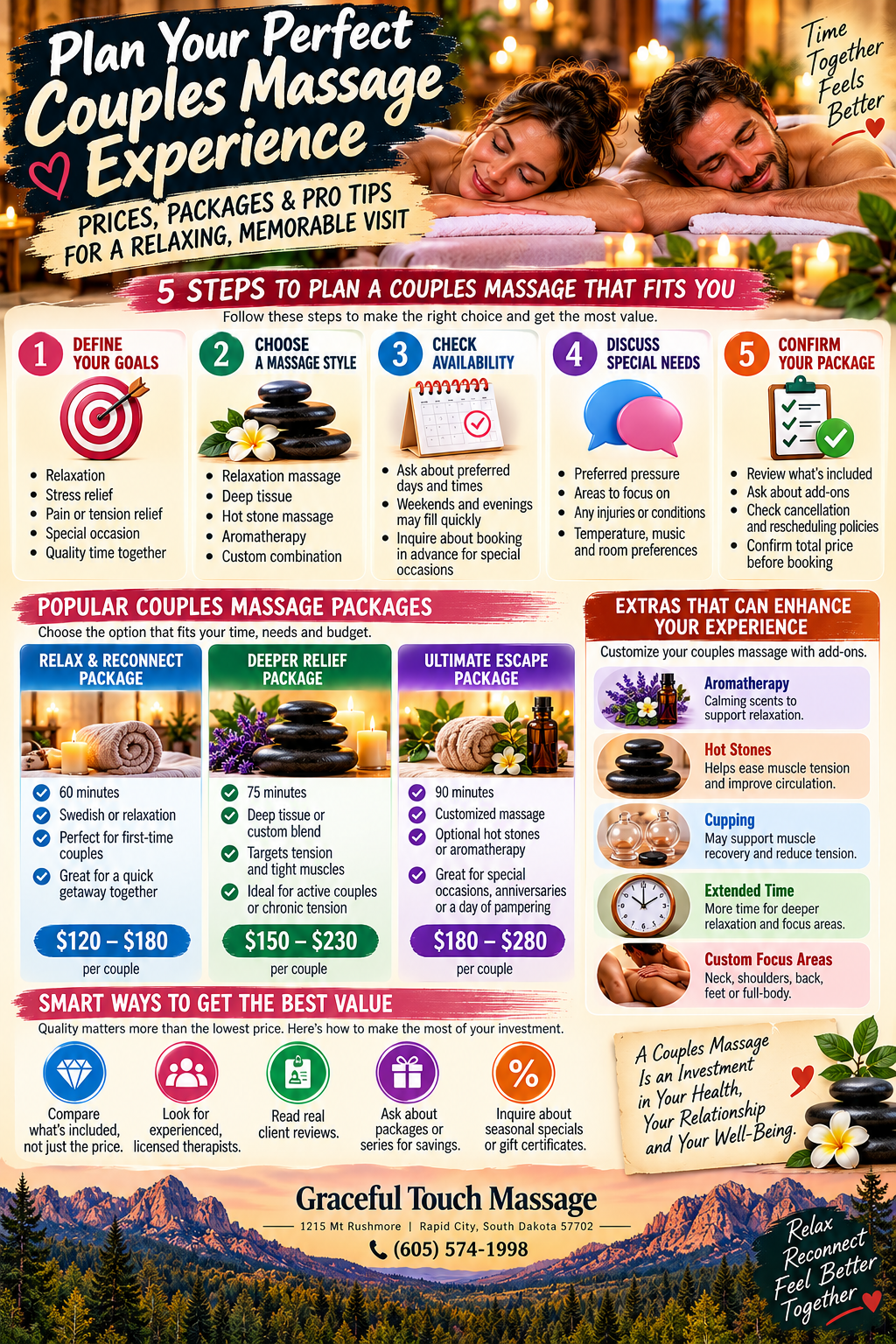
Couples Massage Booking, Prices & Packages
What Should You Expect to Pay for Couples Massage?
Couples massage prices vary considerably.
The total cost may depend on appointment length, location, the number of therapists, service selection, and included amenities.
But price alone doesn't determine value.
Two businesses may advertise the same duration while offering very different experiences.
One may emphasize a luxurious environment.
Another may emphasize individualized massage.
Neither is automatically better.
The right choice depends on what matters to you.
The First Pricing Secret: Confirm What the Advertised Price Includes
A price may be listed per person or for both participants.
A session may be advertised as 60 minutes, but you should confirm how much of that time is hands-on massage.
Some packages include additional amenities.
Others charge separately for enhancements.
Before comparing prices, make sure you're comparing the same things.
What Affects Couples Massage Prices?
Common factors include:
- Session duration.
- Number of therapists.
- Business location.
- Service customization.
- Additional amenities.
- Specialized services.
- Package structure.
- Gratuity policies.
- Appointment restrictions.
Understanding these details helps you avoid surprises.
A Better Way to Compare Massage Value
Consider two hypothetical appointments.
Option A: A 60-minute couples massage for $180 total.
Option B: A 75-minute couples massage for $220 total.
These are examples, not actual Graceful Touch prices.
Option A costs $1.50 per person per advertised minute.
Option B costs approximately $1.47 per person per advertised minute.
The second appointment provides more advertised time at a slightly lower cost per minute.
But that doesn't automatically make it the better choice.
You still need to know whether the appointment includes the experience you want.
If you want focused therapeutic care, an appointment that doesn't accommodate your preferences may be poor value regardless of the price.
Likewise, if you want a chill massage, expensive extras won't compensate for an uncomfortable session.
The Second Pricing Secret: Customization May Be More Valuable Than Amenities
Some packages emphasize elaborate surroundings and added services.
Those features can be enjoyable.
But a comfortable, individualized massage may matter more than additional amenities.
Ask whether each participant can select a different approach.
A package that requires both people to receive identical treatments may not be ideal if their goals differ.
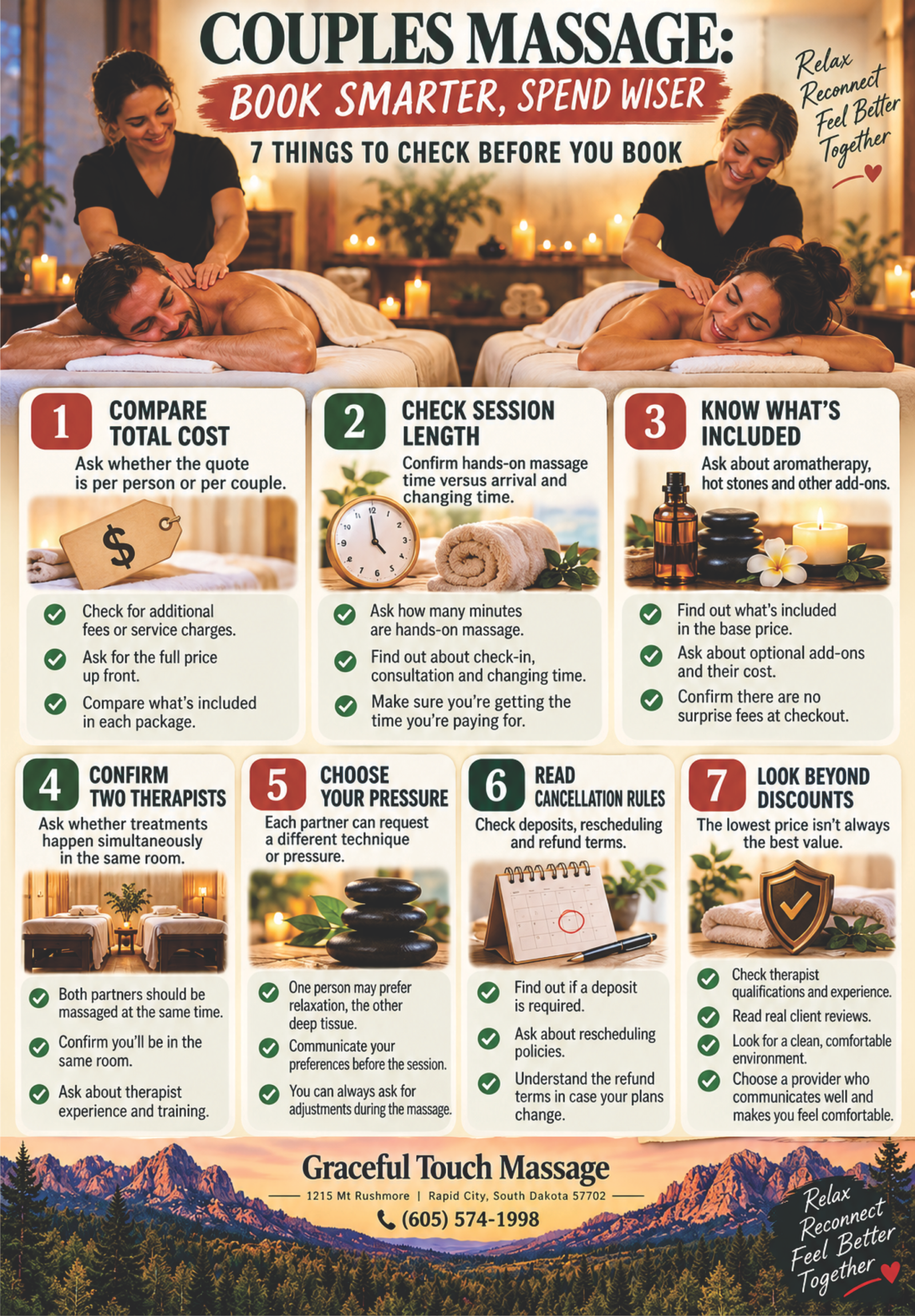
Seven Questions to Ask Before Booking
1. Is the price for both participants?
Confirm the total cost.
2. Will we receive massage simultaneously?
Ask whether the appointment involves two therapists.
3. How much hands-on massage time is included?
Clarify the actual service duration.
4. Can we choose different massage styles?
This matters when one person wants relaxation and the other wants focused therapeutic care.
5. Are enhancements included?
Ask about any additional charges.
6. What are the cancellation and rescheduling policies?
Understand the terms before paying.
7. Are there any other costs?
Clarify gratuity policies, upgrades, and restrictions.
Is a Longer Session Always Better?
Not necessarily.
A longer appointment may allow additional relaxation time or more attention to several areas.
But it may not be necessary for everyone.
Someone seeking a simple, peaceful experience may be satisfied with a shorter session.
Someone wanting focused attention to multiple areas may appreciate additional time.
Choose the duration based on your goals rather than assuming the longest appointment is automatically best.
Couples Massage Packages: When Are They Worth It?
Packages may provide value when they combine services you genuinely want.
Before purchasing, determine whether the package offers flexibility.
Can each person select different treatments?
Can you remove unwanted extras?
Is the full price clear?
Are there scheduling restrictions?
Can the package be used on the date you want?
The answers matter more than the promotional language.
Gift Certificates: A Thoughtful Option With Important Details
A couples massage gift certificate can encourage two people to set aside time together.
Before purchasing, ask:
- What services are included?
- Can the recipients customize their appointments?
- Are additional charges possible?
- How is the appointment scheduled?
- What restrictions apply?
- What are the applicable redemption terms?
Flexibility often makes a gift more useful.
The Third Pricing Secret: The Cheapest Massage Can Be Expensive If It Misses the Goal
Suppose you book a discounted appointment.
The price looks attractive.
But one participant receives uncomfortable pressure and leaves disappointed.
Was the appointment really a good value?
A massage is an experience.
Its value includes comfort, communication, professionalism, and whether the participants received what they wanted.
Price matters.
But it is only one part of the decision.
A Simple Value Checklist
Before booking, confirm:
- The total price.
- The actual massage duration.
- The number of therapists.
- Whether services can be customized.
- Whether both people can receive different approaches.
- What amenities are included.
- What additional charges may apply.
- Whether the provider communicates clearly.
Professional insight: A good couples massage package should support the participants' goals, not require them to accept services they don't want.
Try this: Compare three providers using actual massage time, individual customization, and complete cost—not price alone.
Continue learning: Our Couples Massage Booking, Prices & Packages guide explores value comparisons, package questions, and common pricing misunderstandings.
Couples Massage Near Me & Local Options
How Do You Find the Best Couples Massage Near You?
Searching for “couples massage near me” can produce numerous options.
But search visibility doesn't automatically tell you which provider will best meet your needs.
A better approach begins with identifying what kind of experience you're looking for.
Do you want a genuine relaxation massage?
Do you want focused therapeutic attention?
Do you and your companion want different services?
Do you need accommodations for positioning or mobility?
The answers will help you evaluate providers more effectively.
Look Beyond the Photographs
Beautiful treatment rooms and attractive websites can help you understand a business's environment.
But they don't tell you everything.
They cannot show how well a therapist listens.
They cannot guarantee that pressure preferences will be respected.
And they cannot establish whether the therapist's approach matches your goals.
Look for information about:
- Therapist qualifications.
- Service descriptions.
- Individualized care.
- Communication.
- Accessibility.
- Pricing transparency.
- Client experiences.
- Appointment policies.
What to Look for in Massage Reviews
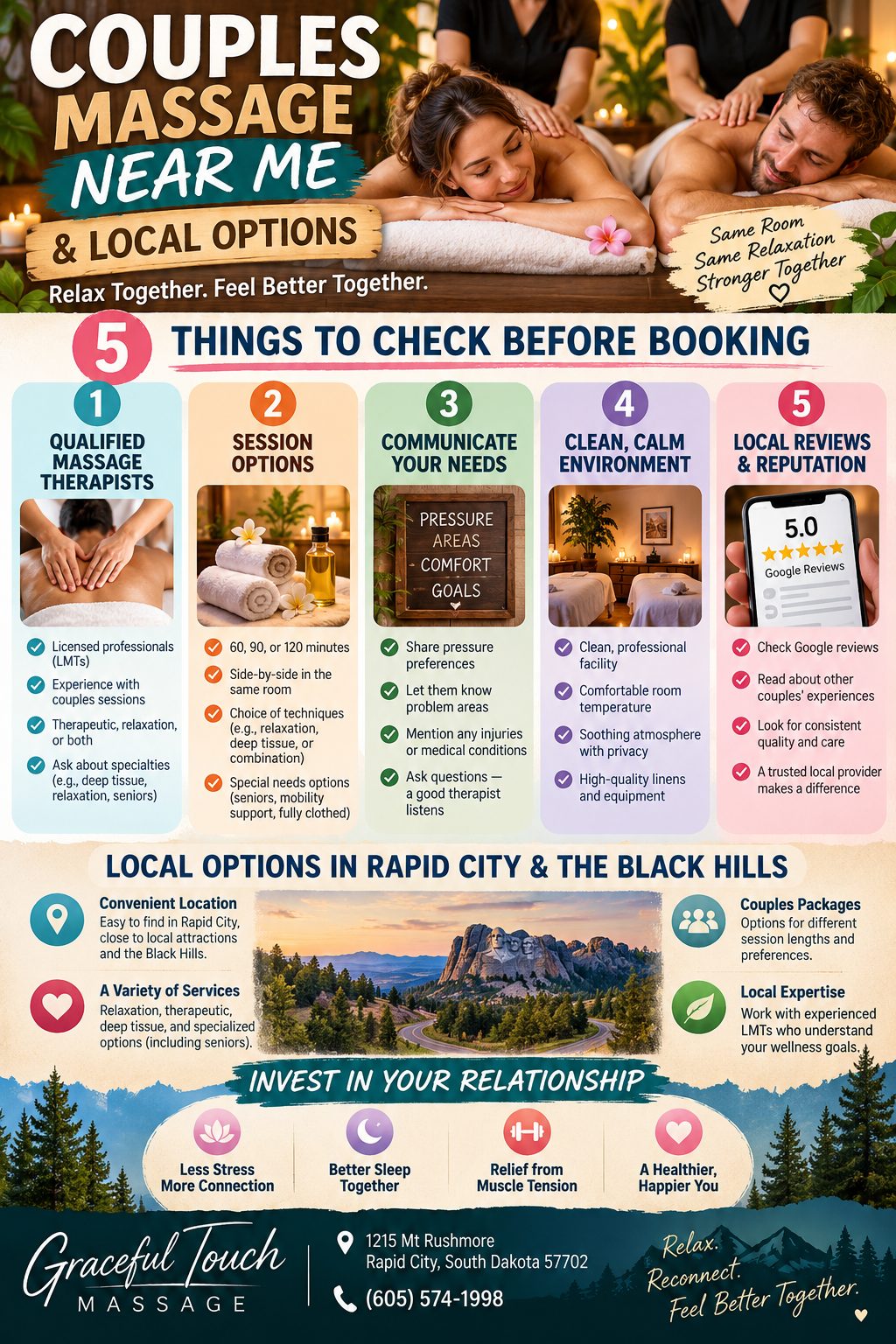
Reviews can provide useful clues about the quality of an experience.
Pay particular attention to comments describing:
Communication: Did the therapist listen?
Comfort: Were pressure preferences respected?
Individualization: Did the therapist adapt the session?
Professionalism: Did the client feel comfortable and respected?
Results: Did the experience accomplish what the client wanted?
A detailed review may provide more useful information than a brief rating.
However, individual reviews don't guarantee that everyone will have the same experience.
Why Therapist Philosophy Matters
Two therapists may both advertise deep tissue massage.
Yet their approaches may be very different.
One may emphasize aggressive pressure.
Another may emphasize careful technique selection and individualized comfort.
A client who has previously experienced painful deep tissue work should ask how the therapist approaches pressure and whether adjustments are welcomed.
Likewise, someone seeking genuine Swedish relaxation should ask whether the therapist will preserve that experience rather than automatically incorporating focused treatment.
Questions to Ask a Local Massage Provider
Before scheduling, consider asking:
- Do you offer couples massage?
- Can each person select a different massage style?
- How do you distinguish relaxation massage from focused therapeutic work?
- How do you handle uncomfortable pressure?
- Can you accommodate mobility or positioning needs?
- How much hands-on massage time is included?
- Are all charges explained before booking?
- Are the therapists appropriately licensed where required?
These questions can help you identify a provider whose approach fits your preferences.
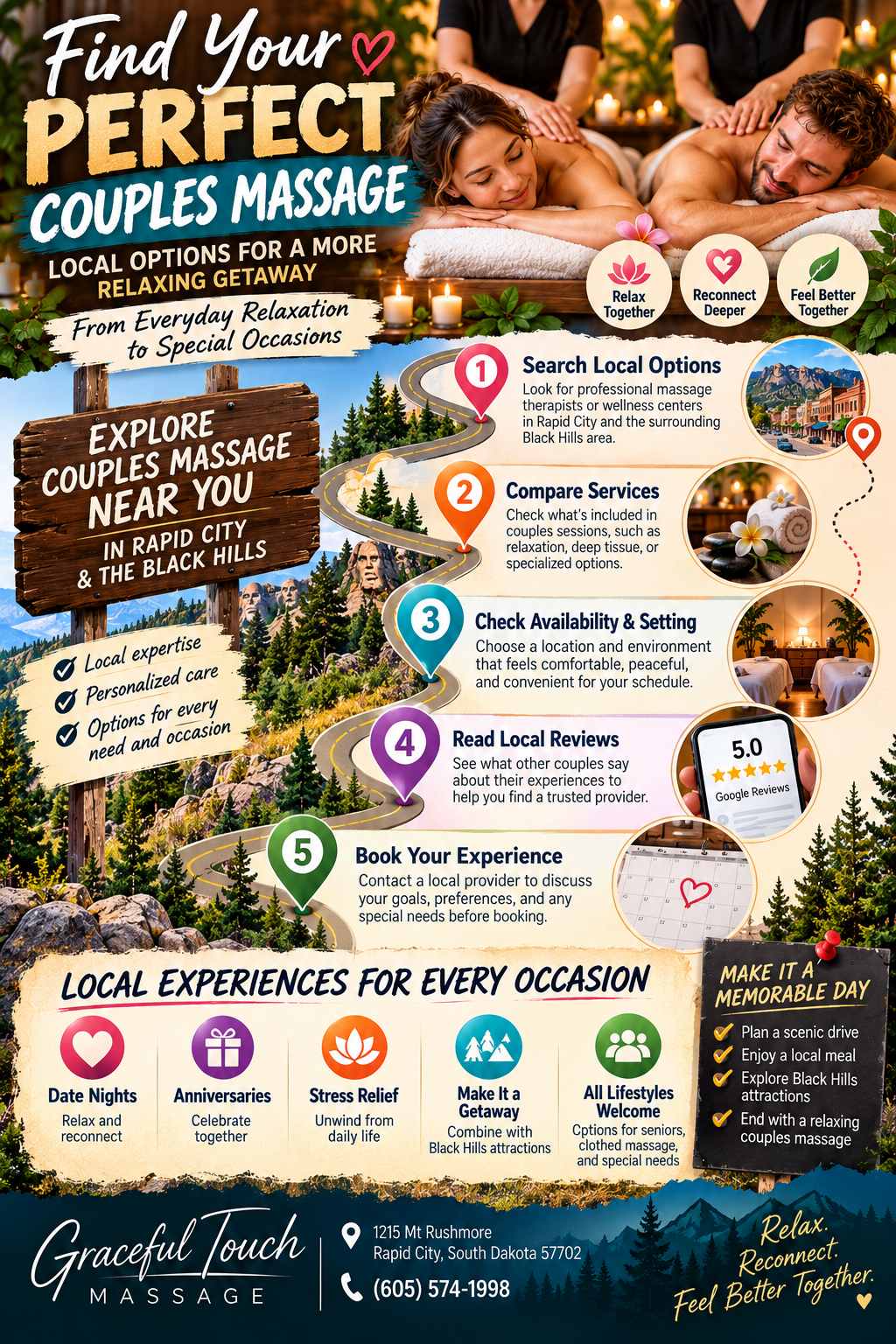
Couples Massage in Rapid City and the Black Hills
For residents and visitors in Rapid City, South Dakota, couples massage can be an enjoyable way to relax and share time together.
Whether you're planning an appointment during a Black Hills visit or looking for a local massage provider, the same principles apply.
Choose the experience you want.
Understand the services being offered.
Communicate your preferences.
And select a business that takes those preferences seriously.
Graceful Touch Massage: A Different Philosophy of Care
At Graceful Touch Massage in Rapid City, I emphasize the importance of matching the massage experience to the individual.
For clients seeking relaxation, I distinguish a genuine Swedish chill massage from focused therapeutic work.
For clients seeking attention to muscular tension, I practice an approach I call Muscle Therapy.
Muscle Therapy combines deep tissue principles with targeted trigger point techniques.
My emphasis is on precision, comfort, and individualized response rather than aggressive force.
That philosophy grew out of a personal experience during my massage therapy education.
I nearly abandoned the profession because I believed the painful, forceful deep tissue approach I experienced was unnecessarily hard on clients and therapists alike.
Instead, I chose to complete my training while committing myself to a different way of working.
Clients have since told me that my approach feels different from massages they've received elsewhere.
Some have also reported longer-lasting relief.
Those experiences are meaningful, but results vary, and they should not be interpreted as guarantees.
Why You Probably Haven't Heard of Muscle Therapy
Most people already recognize terms such as deep tissue massage, trigger point therapy, and massage for muscle tension.
They may not recognize the name Muscle Therapy.
That's understandable because it is the name I use for my own approach, not a universally established massage category.
People generally search for familiar services or the problems they want addressed.
They might search for:
- Deep tissue massage near me.
- Massage for muscle tension.
- Does deep tissue massage hurt?
- Deep tissue massage versus trigger point therapy.
- Massage for tight shoulders.
- Couples massage with different pressure preferences.
Those searches can lead to a larger conversation about the type of massage experience that may be appropriate.
The name matters less than understanding what the client wants.
Frequently Asked Questions
Is couples massage only for romantic partners?
No. Depending on the provider's policies, couples massage may be enjoyed by spouses, partners, friends, or family members.
The important feature is sharing the appointment experience.
Do both people have to receive the same type of massage?
Not necessarily.
Some providers allow each participant to select a different massage style.
Always confirm before booking.
Is Swedish massage the same as relaxation massage?
Swedish massage refers to a recognized collection of massage techniques and is commonly associated with relaxation.
In my practice, I use the term chill massage to describe a deliberately relaxation-centered experience.
Does deep tissue massage have to hurt?
No.
Although some people have experienced aggressive deep tissue massage, unnecessary pain isn't required for focused therapeutic work.
Pressure should be appropriate to the individual.
What is Muscle Therapy?
Muscle Therapy is the name I use for my individualized approach combining deep tissue principles with targeted trigger point techniques.
It is not a separate massage license or a universally established clinical classification.
Why did you develop Muscle Therapy?
During my massage therapy training, I experienced a painful form of traditional deep tissue massage and questioned whether that level of force was necessary.
I also worried about the physical demands that repeatedly performing forceful techniques could place on therapists.
I committed to developing an approach emphasizing precision, comfort, and individualized care rather than unnecessary pain.
Is Muscle Therapy proven to work better than traditional deep tissue massage?
There are no controlled studies establishing that my particular named approach is superior.
Some clients have reported distinctive experiences and longer-lasting relief, but those reports don't prove that everyone will experience the same results.
Should I expect soreness after massage?
Temporary soreness can occur after massage, particularly with unfamiliar or focused techniques.
However, substantial soreness is not a requirement for benefit.
Severe, worsening, or unusual symptoms should be medically evaluated.
Can I request a chill massage even if I have muscle tension?
Absolutely.
Having muscular tension doesn't obligate you to receive focused therapeutic treatment.
If your goal is relaxation, communicate that preference.
What if I want deep tissue massage but don't want painful pressure?
Explain your previous experiences and ask how the therapist approaches focused work.
A therapist should be willing to discuss techniques, comfort, and adjustments.
Is at-home massage a substitute for professional therapeutic massage?
At-home massage can be valuable for gentle relaxation.
It does not replace professional training or medical evaluation when needed.
Your Final Couples Massage Booking Checklist
Before scheduling, confirm:
- Each participant has identified their main goal.
- The business offers the desired services.
- Both people can communicate their pressure preferences.
- Any areas to avoid have been discussed.
- Relevant health or positioning considerations are addressed.
- The appointment length is clear.
- The complete price is understood.
- Cancellation policies are known.
- Both participants feel comfortable with the plan.
Five Lessons Worth Remembering
1. Relaxation is valuable in its own right.
A genuine chill massage should not be treated as an incomplete therapeutic session.
2. Focused massage does not have to mean unnecessary pain.
Aggressive pressure is not the only way to approach muscular tension.
3. Purpose should come before pressure.
Explain what you want the appointment to accomplish.
4. Shared experiences should respect individual differences.
Two people can enjoy the same occasion while receiving different treatments.
5. The memory matters.
A couples massage should be remembered for the enjoyment it provided—not for unwanted discomfort.
Final Thoughts: Choose the Experience You'll Be Glad You Shared
A couples massage is about more than massage techniques.
It's about making time for an experience that matters to both participants.
For some, that means a genuine Swedish chill massage.
For others, it means focused therapeutic attention.
And for many couples, it means finding a provider who can accommodate different preferences within the same shared appointment.
I believe clients deserve to understand their choices.
They deserve to know that relaxation has value.
They deserve to know that meaningful therapeutic work doesn't necessarily require aggressive pressure.
And they deserve to feel comfortable communicating what they want.
Those beliefs aren't just ideas I adopted after becoming a massage therapist.
They were convictions I defended while I was still learning the profession.
I was willing to complete my training, pass the tests, and earn my qualifications.
But I was not willing to build my career around techniques I believed caused unnecessary harm.
That decision continues to influence the way I practice.
“It's not how deep you go. It's how you go deep.”
The best massage isn't the one where the therapist applies the most force or performs the greatest number of techniques.
It's the one that most appropriately serves the person receiving it.
And when two people choose to share that experience, the goal should be to create a memory worth keeping.
Looking for couples massage in Rapid City, South Dakota?
Graceful Touch Massage welcomes conversations about your individual goals, pressure preferences, and available massage services.
Graceful Touch Massage
1215 Mt Rushmore
Rapid City, South Dakota 57702
Phone: (605) 574-1998
Website: https://gracefultouch.org/
About the Author
Guy Siverson, LMT
Graceful Touch Massage
Guy Siverson is a licensed massage therapist practicing in Rapid City, South Dakota.
His professional philosophy began taking shape during massage therapy training, when he challenged a forceful deep tissue approach that he believed caused unnecessary discomfort for clients and excessive physical strain for therapists.
He completed his training while committing himself to an approach emphasizing precision, comfort, and individualized care.
He distinguishes relaxation-focused Swedish massage from therapeutic work and refers to his integrated approach combining deep tissue principles with targeted trigger point techniques as Muscle Therapy.
His guiding statement is:
“It's not how deep you go. It's how you go deep.”
Research and Educational Resources
National Center for Complementary and Integrative Health (NCCIH)
Massage Therapy: What You Need to Know
https://www.nccih.nih.gov/health/massage-therapy-what-you-need-to-know
An accessible summary of research on massage therapy, pain, potential benefits, limitations, and safety.
Denneny et al. (2019)
Trigger Point Manual Therapy for the Treatment of Chronic Noncancer Pain in Adults: A Systematic Review and Meta-analysis
https://pubmed.ncbi.nlm.nih.gov/30025997/
A review finding weak overall evidence for trigger point manual therapy in chronic noncancer pain, with some findings suggesting possible improvements in other outcomes.
Comparative Effectiveness of Manual Therapy Interventions on Pain and Pressure Pain Threshold in Patients With Myofascial Trigger Points (2022)
https://pubmed.ncbi.nlm.nih.gov/36350630/
A network meta-analysis examining different manual therapy interventions for myofascial trigger points.
Criteria Used for the Diagnosis of Myofascial Trigger Points in Clinical Trials on Physical Therapy: Updated Systematic Review (2020)
https://pubmed.ncbi.nlm.nih.gov/32841969/
A review illustrating inconsistencies in how trigger points have been identified in clinical research.
Massage for Neck Pain Contrasted Against Standard Treatment: A Systematic Review Update (2024)
https://pubmed.ncbi.nlm.nih.gov/39593614/
A review examining massage for neck pain, with findings limited by differences between studies and uncertainty in the evidence.
Educational note: This article provides general massage education. Massage is not a substitute for medical diagnosis or treatment. Individual responses and appropriate precautions vary.