Have you ever finished a long day, removed your shoes, and thought, “My feet have had enough!” 😅
Maybe you’ve been standing at work, walking through stores, preparing meals, or exploring the beautiful Black Hills.
Your arches feel tired. Your heels are complaining. Perhaps the balls of your feet feel sensitive.
And now you’re wondering *how to massage tired feet at home* without making them feel worse.
That’s a reasonable question.
But before deciding how much pressure to use, there’s something else worth considering:
Why are your feet uncomfortable in the first place?
I’m Guy Siverson, Licensed Massage Therapist at Graceful Touch Massage in Rapid City, South Dakota.
One of the principles I emphasize is:
Don’t assume. Investigate. Observe.
Let’s explore what contributes to tired feet, how to approach self-massage comfortably, and when additional help may be appropriate.
🔎 Why Do Feet Become Tired After Standing or Walking?
Your feet are remarkable structures.
Each foot contains 26 bones, numerous joints, and an interconnected system of muscles, tendons, ligaments, nerves, and blood vessels.
Every time you take a step, your feet help support your weight, absorb forces, and adapt to the surface beneath you.
Even while standing still, your feet and legs make small adjustments to help maintain balance.
After extended activity, you may notice:
– 🦶 Tiredness across the soles
– 👣 Achiness through the arches
– 🚶 Discomfort around the heels
– 🥿 Tenderness beneath the balls of the feet
– 😮💨 A strong desire to sit down and remove your shoes
These sensations don’t necessarily have the same cause.
A person standing on a hard floor for eight hours may experience different discomfort from someone who has just completed a long hike.
And someone whose feet hurt every morning may be experiencing something different from ordinary end-of-day fatigue.
Feeling uncomfortable tells you something deserves attention. It doesn’t automatically identify the cause.
🏙️ Everyday Activities in Rapid City That Challenge Your Feet
Living in Rapid City provides plenty of opportunities to spend time standing and walking.
Some are recreational. Others are simply part of everyday life.
🛒 Shopping and Running Errands
A trip to the grocery store may not seem demanding.
But add several stops, walking through large stores, carrying purchases, and preparing meals afterward, and you’ve accumulated considerable time on your feet.
Sometimes the discomfort isn’t noticeable until you finally sit down.
👩🍳 Standing at Work
People working in healthcare, retail, restaurants, hospitality, and other occupations may spend long periods standing.
Some walk throughout their shifts.
Others remain in relatively small areas.
Both situations place demands on the feet.
Hard floors, footwear, and limited opportunities to change position may influence comfort.
Standing still for hours isn’t necessarily easier on your feet than walking.
For some people, movement variety makes a noticeable difference.
🏡 Household Activities
Cooking, cleaning, laundry, gardening, and other household responsibilities can keep you on your feet longer than expected.
You don’t need to participate in an athletic event to experience tired feet.
Sometimes ordinary life provides plenty of activity!
🥾 Exploring the Black Hills: Beautiful Scenery, Busy Feet
Rapid City residents and visitors enjoy access to wonderful walking and recreational opportunities.
Places such as Canyon Lake Park, Skyline Wilderness Area, and Custer State Park offer different experiences and walking conditions.
A gentle walk along a relatively level path is different from navigating uneven ground, hills, and rocky trails.
Changes in terrain may require your feet and lower legs to adapt in unfamiliar ways.
And when someone suddenly increases their walking distance, their feet may notice.
💡 Before Your Next Walk, Ask Yourself:
– Are my shoes comfortable for this activity?
– Am I accustomed to walking this distance?
– Will the terrain be different from what I’m used to?
– Have I allowed opportunities for rest?
– Am I noticing discomfort that should change my plans?
Gradually increasing activity may be more comfortable than suddenly attempting a demanding outing.
If foot pain repeatedly interferes with walking, consider having the problem evaluated rather than pushing through it.
The goal is to enjoy the Black Hills—not spend the following day regretting every step! 😄
👟 Could Your Shoes Be Part of the Problem?
When feet become uncomfortable, footwear is often one of the first things people question.
Sometimes that makes sense.
Shoes affect how your feet interact with the ground.
A shoe that’s too narrow, rubs against the heel, or creates uncomfortable pressure may contribute to irritation.
But here’s something important:
The most expensive shoe isn’t automatically the most comfortable shoe for you.
🔎 Five Questions to Ask About Your Shoes
1. Do my toes have enough room?
2. Does the heel fit securely without uncomfortable rubbing?
3. Are there pressure points that develop during the day?
4. Are these shoes appropriate for my activities?
5. Do my feet feel noticeably different when I wear another pair?
Your answers may reveal useful patterns.
However, changing shoes won’t resolve every cause of foot discomfort.
Persistent or unexplained pain deserves appropriate evaluation.
🚶 Movement Variety: A Simple Foot-Care Habit
Imagine standing at a counter for several hours.
You might shift your weight occasionally, but your feet spend much of that time in a similar position.
Now imagine spending those same hours walking continuously.
That’s a different physical demand.
Neither situation is automatically ideal for everyone.
But it illustrates why movement variety matters.
Depending on your circumstances, you may find it helpful to:
– Change standing positions periodically.
– Take comfortable walking breaks when appropriate.
– Sit and rest when your feet become fatigued.
– Avoid remaining in one uncomfortable position unnecessarily.
– Notice which activities leave your feet feeling better or worse.
These aren’t treatments for a medical condition.
They’re everyday habits that may help you better understand and manage ordinary activity-related fatigue.
The important part is observing your response.
🖐️ How to Massage Tired Feet at Home Without Excessive Pressure
If you’re learning *how to massage tired feet at home*, one of the most important things to understand is that stronger pressure isn’t automatically better.
Some people believe massage must hurt to accomplish something.
But discomfort isn’t proof that massage is working.
And a tender spot doesn’t automatically mean you’ve discovered the source of a problem.
Different areas of the feet respond differently to pressure.
The arch may feel different from the heel.
The ball of the foot may be more sensitive than another area.
And a spot that feels tender today may feel different tomorrow.
💡 Guy’s Massage Principle
*It’s not how deep you go. It’s how you go deep.*
At Graceful Touch Massage in Rapid City, I encourage people to communicate about pressure, comfort, and how their body responds.
Deep tissue doesn’t need to hurt.
The same thinking applies to self-massage.
A comfortable, deliberate approach allows you to notice your response without turning a relaxing activity into an endurance test.
🔎 How Can You Tell Whether Self-Massage Helped?
Instead of judging massage by how intense it feels, consider whether your comfort changes afterward.
Do your feet feel more relaxed?
Is standing or walking more comfortable?
Did some areas respond differently from others?
Or did you notice no change?
No change is still useful information.
It doesn’t mean you failed.
And it certainly doesn’t mean you should automatically press harder.
🦶 Want the Complete Five-Minute Foot Self-Massage Routine?
I’ve created a practical, step-by-step lesson in our Deep Tissue Facebook Group:
Tired, Achy Feet? Try This 5-Minute Foot Self-Massage Routine
You’ll discover how to approach foot self-massage with comfortable pressure, explore different areas of your feet, and compare how they feel before and afterward.
👉 https://web.facebook.com/groups/deeptissue/posts/1598880458391022
♿ Foot Self-Care for Older Adults and People With Mobility Limitations
Not everyone can comfortably reach their feet.
Some people have limited hip or knee mobility.
Others use wheelchairs, walkers, or other mobility aids.
And some older adults find that traditional massage positions impractical.
That doesn’t mean they should force themselves into uncomfortable positions.
Good care should adapt to the person.
🪑 Comfortable Positioning Matters
A supportive chair and stable footrest may make everyday foot care easier.
For some people, assisted foot care may be more appropriate than trying to reach their feet independently.
Professional massage may also be adapted to accommodate mobility limitations.
At Graceful Touch Massage in Rapid City, massage can be adapted for people who need to remain in a recliner, wheelchair, or another supported position.
The goal is to provide appropriate care without requiring someone to fit a traditional massage-table position.
⚠️ When Additional Caution Is Necessary
People with diabetes-related sensory changes, neuropathy, circulation problems, or conditions affecting blood clotting should consult their healthcare professional before trying foot massage.
When sensation is reduced, it may be difficult to recognize excessive pressure or irritation.
For some individuals, even seemingly gentle techniques may be inappropriate.
Comfort, sensation, and safety must come before technique.
⚠️ When Is Foot Pain More Than Ordinary Tiredness?
It’s important not to assume every uncomfortable foot simply needs massage.
Consider professional evaluation if you experience:
– Persistent or worsening foot pain
– Numbness or tingling
– Unexplained swelling
– Pain that interferes with walking
– Changes in skin color or temperature
– Wounds that aren’t healing
– Discomfort following an injury
Sudden severe pain, inability to bear weight, or a foot that becomes cold, pale, or blue warrants prompt medical attention.
A qualified healthcare professional can help determine whether further evaluation or treatment is necessary.
Massage therapy shouldn’t replace that evaluation.
And attempting to massage away unexplained symptoms may delay appropriate care.
🤝 When Might Professional Massage Therapy Be Helpful?
Professional massage can be an option for relaxation, muscle tension, and general comfort.
But a successful massage session involves more than pressure.
It also involves listening.
At Graceful Touch Massage, I encourage clients to speak up.
If pressure feels excessive, say so.
If positioning is uncomfortable, ask about alternatives.
If something doesn’t seem helpful, communicate that.
The therapist and client should work together.
Massage should be a therapeutic partnership—not something you simply endure.
🔎 Try This: Identify Your Biggest Foot-Fatigue Trigger
Before deciding what to do about your tired feet, investigate one thing.
Think about your typical day.
Which activity most often leaves your feet uncomfortable?
Is it:
– 🛒 Shopping or errands?
– 👩🍳 Standing at work?
– 🥾 Walking or hiking?
– 🏡 Household activities?
– 🚗 Getting back on your feet after a long drive?
– 👣 Something else?
Now consider three questions.
1. When does the discomfort begin?
Does it appear after a certain amount of activity?
2. What seems to influence it?
Does rest, changing position, or different footwear make a difference?
3. Does the discomfort resolve or repeatedly return?
These observations won’t diagnose a medical condition.
But they may help you recognize patterns and communicate more effectively if professional evaluation becomes necessary.
🌿 Final Thoughts: Your Feet Deserve Attention, Not Punishment
Your feet carry you through work, recreation, family activities, and everyday responsibilities.
Whether you’re walking around Rapid City or exploring the Black Hills, they deserve reasonable care.
But foot comfort isn’t about finding the strongest possible massage.
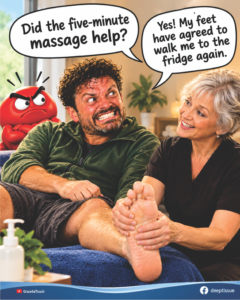
It’s about recognizing what your feet experience throughout the day and making thoughtful decisions about comfort, movement, footwear, and self-care.
Gentle self-massage may be one useful option.
It isn’t the answer to every problem.
Remember:
Don’t assume. Investigate. Observe.
And one of my favorite principles:
It’s not how deep you go. It’s how you go deep.
💬 Ready to Try the Complete Foot Self-Massage Lesson?
If your feet are tired after ordinary activity and self-massage is appropriate for you, today’s Deep Tissue Facebook Group lesson provides the complete five-minute routine and a simple before-and-after comfort check.
👉 https://web.facebook.com/groups/deeptissue/posts/1598880458391022
👤 About the Author
Guy Siverson is a Licensed Massage Therapist and owner of Graceful Touch Massage in Rapid City, South Dakota. His educational approach emphasizes comfortable pressure, therapeutic communication, practical self-care, and adapting massage to individual needs.
Graceful Touch Massage
1215 Mt Rushmore
Rapid City, South Dakota 57702
📞 605.574.1998
🌐 http://GracefulTouch.org
Educational information only. This article is not intended to diagnose or treat a medical condition.