Feeling stiff after sitting for a long time?
Maybe your neck doesn’t turn as comfortably as it did earlier. Your shoulders feel restricted. Your lower back complains when you stand. Or those first few steps after getting out of the car feel surprisingly awkward. 😄
It’s easy to immediately decide:
“I need to stretch this.”
“I need to massage that.”
Maybe.
But before deciding what that stiff area needs, consider a much simpler question:
How long have you been in basically the same position?
I’m Guy Siverson, LMT with Graceful Touch Massage in Rapid City, South Dakota. One thing I encourage people to consider is what their body was doing before the stiffness got their attention.
🪑 Feeling Stiff Doesn’t Automatically Mean Something Needs Stretching
Stiffness gets our attention because we often notice it when we finally move.
Think about what may have happened beforehand.
You sat through a meeting.
You worked at your computer.
You spent the evening on the couch.
You drove for several hours.
You stood at the same workstation.
Then you changed position and thought:
“Wow, I’m tight.”
But *feeling stiff and knowing why you feel stiff are not the same thing.*
And feeling stiff doesn’t automatically tell you what you should do about it.
Stretching isn’t bad.
Massage isn’t bad.
The better question is whether we sometimes jump to a solution before paying attention to what happened first.
💻 Your Workday May Be Part of the Story
Consider an ordinary day at a desk.
You start working.
An hour passes.
Then another.
You answer emails, look at your phone, work on a project, and suddenly realize you’ve barely changed position.
Then you stand up.
Your back feels stiff.
Your shoulders feel restricted.
Your neck doesn’t turn quite as comfortably.
Naturally, your attention goes directly to the area that feels different.
But instead of immediately asking:
“What muscle do I need to stretch?”
Try asking:
“How long have I been doing essentially the same thing?”
That changes the way you investigate the problem.
🚗 Driving Can Make the Same Pattern Really Obvious
You don’t have to work at a desk to experience this.
Driving is another great example.
Here in Rapid City, longer drives through western South Dakota or around the Black Hills can mean spending quite a bit of time in one position.
Then you arrive.
You open the door.
You stand up.
And suddenly your body has opinions. 😂
Your hips feel stiff.
Your back feels restricted.
Your shoulders may feel like they’ve been holding the steering wheel all day.
It’s tempting to immediately label the sensation:
“My back needs stretching.”
“My hamstrings are tight.”
“I need somebody to work on this.”
Maybe.
But first remember:
You just spent a long time doing almost the opposite of moving.
🚶 Movement Doesn’t Have to Mean Exercise
When I suggest changing position and moving, I’m not necessarily talking about starting an exercise routine.
That can make a very simple idea unnecessarily complicated.
You don’t necessarily need:
🏋️ A workout
🧘 A stretching routine
⏱️ Thirty minutes
👟 Exercise clothes
🛠️ Special equipment
Sometimes the first thing to explore is simply *stopping what you’ve been doing and giving your body a different input.*
Stand instead of sit.
Walk instead of remaining still.
Let your body experience some comfortable movement.
Then pay attention.
The goal isn’t exercise. The goal is information.
🔎 What Happens After You Change Position?
This is where the idea becomes much more useful.
Before changing anything, notice what you’re experiencing.
Perhaps turning your head feels restricted.
Maybe raising your arms feels different.
Maybe standing feels stiff.
Maybe those first few steps aren’t as comfortable as usual.
Now change what you’ve been doing.
Afterward, notice that same comfortable movement again.
Did anything change?
Does it feel easier?
About the same?
Different?
Worse?
You haven’t diagnosed anything.
You haven’t proven what caused the stiffness.
You’ve simply gathered another piece of information about *how your body responded when you changed the input.*
💡 Change the Input Before Deciding You Need to Treat the Output
This is the bigger lesson.
We tend to notice the output:
“My neck is stiff.”
“My back feels tight.”
“My shoulders are restricted.”
Then we immediately start looking for something to do to that area.
Stretch it.
Massage it.
Roll it.
Heat it.
Cool it.
But what if we first considered the input?
Hours at a desk.
A long drive.
An evening on the couch.
Looking down at a phone.
Standing at the same workbench.
CHANGE THE INPUT BEFORE DECIDING YOU NEED TO TREAT THE OUTPUT.
That doesn’t tell you exactly why something feels stiff.
It does something simpler and potentially more useful:
It gives you another piece of information before you choose what to do next.
🙌 Where Does Massage Therapy Fit?
As a massage therapist, I obviously believe massage can be valuable.
But I don’t believe every uncomfortable sensation automatically means you need another massage.
At Graceful Touch Massage in Rapid City, I want people to become better observers of what happens between their appointments—not simply wait until something bothers them enough to schedule another one.
Sometimes massage may make sense.
Sometimes changing what you do during your day may be worth exploring.
Sometimes what you’re experiencing doesn’t respond to a simple change in movement.
The goal is not to have one answer for every stiff muscle.
Good self-care includes paying attention to what happens next.
⚠️ Comfortable Movement Is the Goal
This discussion is about ordinary stiffness associated with things such as prolonged sitting, driving, desk work, or remaining in one position.
It isn’t a method for diagnosing or treating an injury.
Movement should be comfortable rather than forced.
If you experience significant pain, dizziness, new numbness or weakness, have a significant or recent injury, or have other concerning symptoms, don’t simply push harder through self-treatment. Appropriate professional evaluation may be warranted.
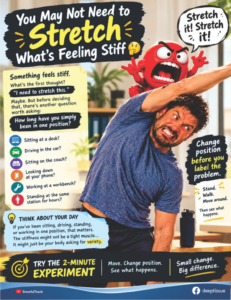
🎯 Want to Try the Actual 2-Minute Experiment?
There’s an important difference between understanding this idea and actually testing it.
That’s why I’ve put the complete *2-minute movement experiment* in today’s Deep Tissue Facebook post.
It starts by having you notice a comfortable movement before changing anything.
Then you change what your body has been doing.
Then you retest.
That’s where you get to answer the question:
Did anything actually change?
Try the complete 2-minute movement experiment here:
👉 https://web.facebook.com/groups/deeptissue/posts/1598068411805560
❓ Frequently Asked Questions
Why do I feel stiff after sitting?
Remaining in one position for a long period can be part of the context in which you notice stiffness when you begin moving again. Instead of immediately assuming a particular muscle needs treatment, consider what you were doing beforehand and what happens after you comfortably change position.
Should I stretch when I feel stiff after sitting?
Stretching may feel good, but stiffness alone doesn’t necessarily tell you that stretching is what you need. Changing position and moving comfortably first can give you additional information before deciding what to try.
Can sitting at a desk make my neck and shoulders feel stiff?
People commonly notice stiffness after spending extended periods working at a computer or remaining in similar positions. Paying attention to how long you’ve stayed in one position—and what happens when you change it—can provide useful context.
Should I get a massage for stiffness?
Massage may be one option, but feeling stiff doesn’t automatically mean you need massage therapy. Consider when the stiffness occurs, what you’ve been doing, and whether comfortable changes in position and movement affect what you notice.
About the Author
Guy Siverson, LMT, is a licensed massage therapist with Graceful Touch Massage in Rapid City, South Dakota. His approach to massage and self-care education encourages people to pay attention to how their bodies respond rather than automatically treating every stiff or uncomfortable area the same way. His goal is to help people better understand their options, communicate what they are experiencing, and make more informed decisions about when self-care may be enough and when massage therapy or further evaluation may be appropriate.
Graceful Touch Massage
1215 Mt Rushmore
Rapid City, South Dakota 57702
(605) 574-1998