What to Expect at Your First Massage — The Questions Nobody Thinks to Ask
Most people arrive at their first professional massage with the same combination of excitement and low-grade uncertainty.
They’re not sure what to wear. They’re not sure how much to undress. They’re not sure whether they’re supposed to talk, stay quiet, or say something when the pressure isn’t quite right. They’ve heard massage is relaxing. They’re just not entirely sure what’s about to happen.
If that sounds familiar, you’re in good company. First massages are almost universally a little confusing — not because the process is complicated, but because nobody explains it beforehand.
This article is that explanation.
👕 What Should You Wear to a Massage?
This is the question most first-time clients wonder about but feel awkward asking.
The short answer: wear whatever you’re comfortable in to travel to and from the appointment. What you wear underneath is up to you.
Most massage clients undress to their level of comfort. Some clients remove all clothing. Others prefer to keep their underwear on. Both are completely appropriate, and a professional therapist will work with whatever you’re comfortable with.
You will be covered by a sheet and blanket throughout the session. Your therapist will only undrape the area being actively worked on. Nothing will be exposed beyond what is necessary for the massage, and you can always ask for more coverage if you’d prefer it.
If you have specific concerns about draping or clothing before your first appointment, call ahead and ask. A professional therapist is happy to answer those questions — they’ve heard them before, and there’s nothing unusual about asking.
🤔 Do You Have to Remove All Your Clothing?
No. This is one of the most common concerns first-time clients have, and the answer is clear: you undress only to the level you’re personally comfortable with.
If you’d prefer to keep your clothing on entirely, that’s a conversation to have with your therapist before the session. Depending on the type of massage and the areas you want addressed, your therapist may be able to work through light clothing. For certain types of bodywork, staying fully clothed is entirely standard.
The key is communication. Tell your therapist your preferences before the session begins, and they’ll work with you.
💬 What Should You Tell Your Therapist Before the Massage?
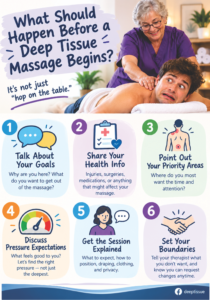
The intake conversation at the beginning of a massage appointment is one of the most valuable parts of the experience — and one that first-time clients often don’t know to take seriously.
Before your first massage, think about:
📍 Where you’re experiencing tension or discomfort. Specific is better than general. “My left shoulder has been bothering me for about two weeks, especially when I turn my head to the right” gives your therapist significantly more to work with than “my shoulder hurts.”
🎯 What you want to feel when you leave. Relaxed? Less pain in a specific area? More mobile? Better able to sleep? These goals help your therapist make decisions throughout the session.
⚖️ Your pressure preferences. If you know you tend to prefer lighter or firmer work, say so at the start. If you’re not sure, that’s fine too — your therapist will check in with you as the session progresses.
🏥 Any health considerations. Recent injuries, surgeries, medications, conditions like high blood pressure or pregnancy — all of this is relevant information for your therapist to have before beginning.
🛑 Anything you’d prefer not to have worked on. If there are areas you’d rather your therapist skip entirely, say so. You don’t need to explain why.
🗣️ Is It Okay to Talk During a Massage?
Yes — and more importantly, it’s okay to speak up about anything that isn’t working.
Many first-time clients stay silent through an entire session because they don’t want to seem difficult or interrupt the therapist’s work. The result is a massage that doesn’t quite deliver what they needed, and a client who leaves without saying anything.
Your therapist would rather know.
If the pressure is too much, say something. If you’d like more pressure in a particular area, say something. If you’re cold, if a position is uncomfortable, if you want more time spent somewhere — say something. All of that is useful information that allows your therapist to make the massage better while there’s still time to do so.
Good communication isn’t a complaint. It’s how a good massage actually happens.
That said, if you prefer a quiet session and don’t want conversation, that’s equally valid. Tell your therapist at the start. Most therapists follow the client’s lead — if you want to talk, they’ll engage; if you want silence, they’ll give you silence.
🎯 What Should the Pressure Feel Like?
This is probably the question most first-time massage clients have and least often ask.
Appropriate pressure is not the same as painful pressure. Deep tissue massage, in particular, has developed a cultural reputation for being painful — as if more intensity automatically means more benefit. That’s not how it works.
Therapeutic pressure should feel like a productive level of discomfort — the kind where something real is happening in the tissue, but you’re not gripping the table or holding your breath. The moment you’re tightening against the therapist, the session has moved beyond what’s useful.
If something hurts in a way that feels wrong, say so immediately. Your therapist will adjust.
First-time clients often don’t have a strong sense of their own pressure preferences yet — and that’s completely normal. After a few sessions, you’ll have a much clearer idea of what works for your body. In the meantime, checking in with your therapist throughout the session is the best way to calibrate.
🌿 What Happens After the Massage?
After your session ends, your therapist will typically leave the room briefly so you can dress. Take your time. Most people feel relaxed to the point of mild disorientation after a good massage — moving slowly for a minute or two is normal and encouraged.
A few things worth knowing for after your massage:
💧 Drink water. Massage increases circulation and lymphatic activity. Staying hydrated supports the body’s recovery process in the hours that follow.
🤕 You may feel sore. Particularly after deep tissue work, some soreness in the hours following a massage is normal — similar to what you might feel after exercise. This typically resolves within 24 to 48 hours.
😴 You may feel tired. The parasympathetic nervous system response that a good massage produces can leave you feeling genuinely sleepy. If possible, avoid scheduling high-demand activities immediately after a session.
📝 Give yourself time to evaluate. How do you feel the day after? What changed, what didn’t, what would you want more or less of next time? That information helps you communicate better with your therapist at the next appointment.
⚠️ What If Something Felt Wrong?
If something happened during your massage that made you uncomfortable — whether it was pressure, draping, communication, or anything else — it’s worth saying something, either during the session or afterward.
A professional therapist will receive that feedback seriously and adjust accordingly. If the experience left you uncertain about returning to that particular therapist, trust that instinct. The right therapist for you is one with whom you feel comfortable, heard, and respected throughout the entire session.
Not every therapist is the right fit for every client. Finding a good match is part of the process.
💆 Your First Massage Story
First massages are more memorable than people expect. Whether you were confused about what to wear, stayed quiet when you should have spoken up, or had absolutely no idea what was happening — those experiences are far more common than most people admit.
We’d love to hear yours.
What’s the one thing you wish someone had explained to you before your first massage?
Share your experience in our Facebook community — massage therapists and clients talking honestly about what the experience is really like:
👉 https://web.facebook.com/groups/deeptissue/posts/1578492967096438
Join our community 👉 Find the Right Massage Therapist | Deep Tissue Massage & Massage Therapy Tips on Facebook
Graceful Touch Massage | 1215 Mt Rushmore Rd, Rapid City, SD | 605-574-1998